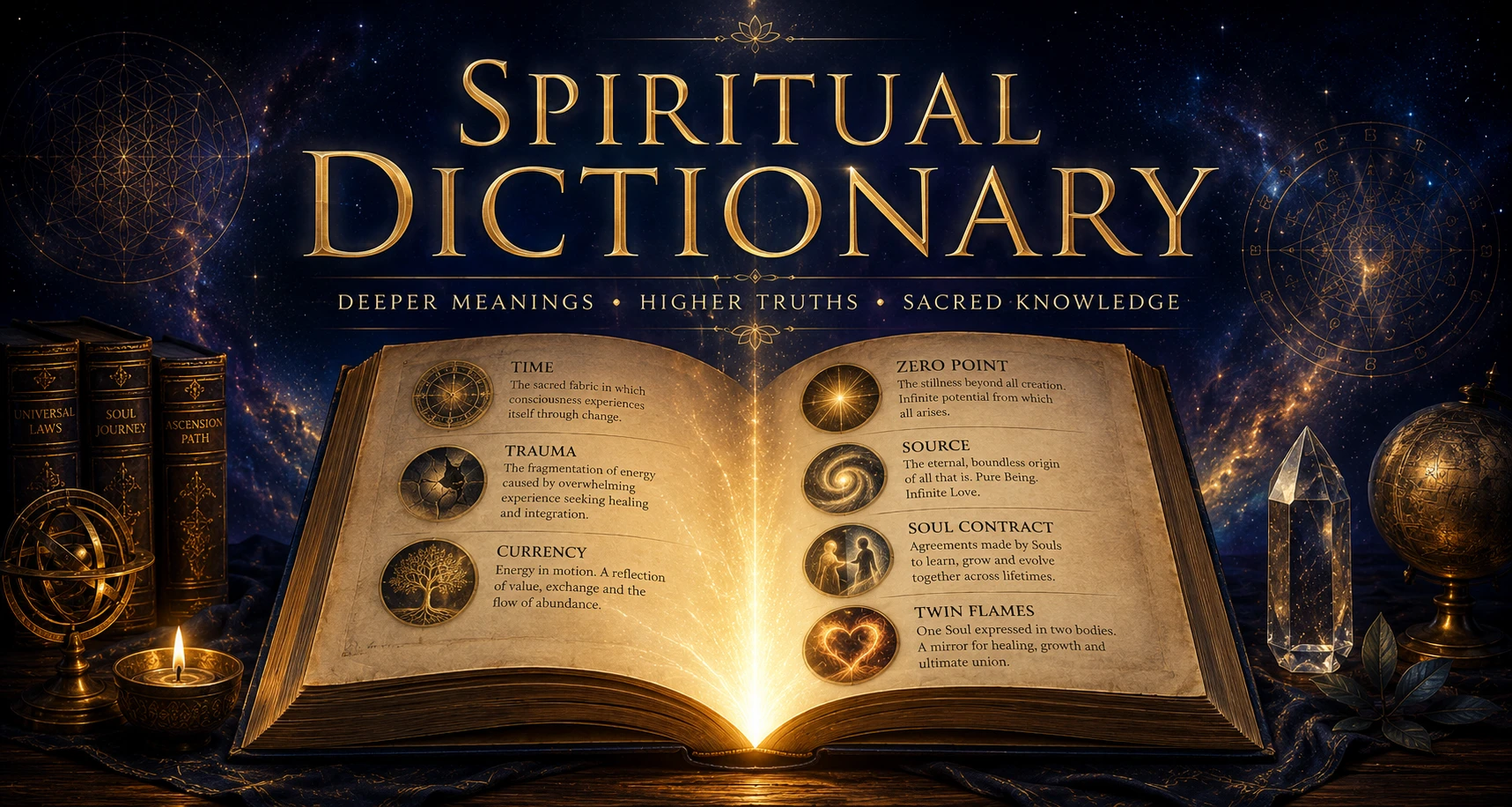
Spiritual Dictionary
205 Spiritual Terms & Meanings
Last Updated August 2026
The Serapis Light Spiritual Dictionary is an expanding glossary of 205 spiritual terms, concepts, practices, and states of consciousness — from Awakening, Ascension, Karma, and the Higher Self to Trauma, Shadow Work, Soul Contracts, and Unity Consciousness.
Each entry offers a clear definition, deeper explanation, key insights, and related concepts through a unified framework centered upon Love, Light, Truth, personal responsibility, direct experience, and embodied consciousness.
New to Spirituality? Start with the Simple Spiritual Dictionary.
Search dictionary term titles.
205 terms available
No matching terms found
Try a related word or visit the Simple Spiritual Dictionary.
A
Acceptance
Definition:
Acceptance is the conscious recognition of reality as it presently exists without denial, resistance, or emotional avoidance.
Acceptance does not mean passivity, resignation, or approving harmful circumstances. Instead, it creates clarity by ending the internal conflict created through resisting what already is.
Only what is fully acknowledged can be consciously transformed.
Spiritually, Acceptance dissolves unnecessary suffering by allowing awareness, responsibility, and conscious action to emerge from clarity rather than emotional resistance.
Key Insights
- Resistance intensifies suffering.
- Acceptance creates clarity and emotional space.
- Transformation begins with honest acknowledgment.
- Acceptance and responsibility strengthen one another.
Related Terms:
Presence, Healing, Inner Peace, Forgiveness, Awareness
Accountability
Definition:
Accountability is the willingness to acknowledge one’s choices, actions, impact, patterns, responsibilities, and consequences without denial, manipulation, blame-shifting, or collapse into shame.
Accountability differs from punishment. Its purpose is Truth, repair, learning, changed behavior, and the restoration of integrity.
Forgiveness does not remove accountability, nor does accountability require permanent resentment or revenge.
In relationship, reconciliation becomes possible only when accountability is sincere enough to produce safety, repair, and consistent transformation.
Key Insights
- Accountability faces impact honestly.
- It differs from shame and punishment.
- Words without changed behavior are incomplete.
- Forgiveness and accountability can coexist.
- Repair requires responsibility from the person who caused harm.
Related Terms:
Responsibility, Integrity, Forgiveness, Reconciliation, Self-Blame
Activation
Definition:
Activation is the awakening, unlocking, or amplification of dormant consciousness, energetic capacity, remembrance, or Soul-aligned potential.
Spiritually, Activation occurs when a person encounters experiences, teachings, frequencies, insights, or energetic conditions that catalyze inner transformation and expanded awareness.
An Activation may feel sudden or gradual. It can manifest emotionally, mentally, spiritually, energetically, or physically as old structures dissolve and new levels of awareness emerge.
True Activation is not external power being given to someone. It is the awakening of what already exists within.
Without grounding and integration, however, Activation can become destabilizing or Egoically distorted.
Key Insights
- Activation awakens dormant potential and remembrance.
- Transformation often follows energetic shifts.
- Integration is essential after Activation.
- True Activation comes from within, not outside authority.
Related Terms:
Ascension, Kundalini, Consciousness, Soul, Transformation
Akash
Definition:
Akash refers to the subtle energetic field of consciousness that stores memory, experience, information, and Soul-level imprint across lifetimes and dimensions. It itself is 6-dimensional in nature.
Often described as an energetic archive or field of remembrance, the Akash contains patterns connected to individual and collective consciousness.
On Earth, the Internet operating across (infinite) digital Cloud storage space, storing all available information, most accurately represents the Akash and the Quantum field.
Spiritually, access to the Akash may occur through intuition, dreams, meditation, deep states of awareness, or spontaneous remembrance.
Note: The Quantum Field greatly overlaps and integrates with the Akash, yet it is not the exact same.
Discernment remains essential, as imagination and projection can easily distort interpretation.
Key Insights
- The Akash relates to energetic memory and consciousness.
- Access often occurs through heightened awareness.
- Emotional and energetic clarity improve discernment.
- The Akash connects personal and collective evolution.
Related Terms:
Soul, Reincarnation, Intuition, Consciousness, Past Lives, Quantum Field
Alchemy
Definition:
Alchemy is the spiritual process of transforming lower states of consciousness into higher coherence, awareness, wisdom, and embodied Truth.
Historically symbolized through the transformation of base metals into gold, true Alchemy refers primarily to inner transformation rather than material transmutation.
Spiritually, Alchemy transforms:
- Fear into Love,
- suffering into Wisdom,
- Trauma into healing,
- unconsciousness into Awareness,
- and separation into Unity.
This process requires conscious integration, responsibility, purification, and embodiment rather than suppression or denial.
Key Insights
- Spiritual Alchemy transforms inner distortion into coherence.
- Suffering can become Wisdom through conscious integration.
- Transformation requires embodiment and Responsibility.
- True Alchemy occurs within consciousness itself.
Related Terms:
Transformation, Purification, Healing, Consciousness, Awakening
Alignment
Definition:
Alignment is the state in which thoughts, emotions, actions, values, and consciousness operate coherently with Truth and inner integrity.
When aligned, a person experiences greater clarity, peace, vitality, authenticity, and energetic flow. Misalignment often manifests as inner conflict, exhaustion, confusion, emotional heaviness, or repeated resistance.
Alignment is not perfection. It is the ongoing process of bringing one’s inner and outer life into greater coherence.
Spiritual growth continuously reveals areas where deeper alignment is possible.
Key Insights
- Alignment creates energetic coherence.
- Misalignment generates inner friction and resistance.
- Authenticity strengthens alignment.
- Conscious action reinforces aligned living.
Related Terms:
Truth, Presence, Manifestation, Authenticity, Energy
Angel Numbers
Definition:
Angel Numbers are repeating numerical sequences believed to carry symbolic meaning, energetic resonance, or messages connected to consciousness and alignment.
Common sequences such as 111, 222, 444, or 1111 often appear during periods of awakening, transition, reflection, or heightened awareness.
Spiritually, these numbers function less as supernatural commands and more as mirrors reflecting inner states, energetic movement, and conscious alignment.
Their meaning deepens through intuition, self-awareness, and context rather than rigid interpretation.
Key Insights
- Angel Numbers often appear during transformation and awakening.
- Repeating numbers act as symbolic reflections.
- Context and intuition shape interpretation.
- Numbers invite awareness rather than dependency.
Related Terms:
Numerology, Synchronicity, Consciousness, Intuition, Alignment
Angels
Definition:
Angels are higher-dimensional expressions of divine benevolence, guidance, protection, and support.
Spiritually, Angels are not merely winged beings or religious symbols, but expressions of Heaven’s quality as radiant allowance, Love, and presence.
They may be experienced as inner reassurance, synchronicity, intuitive guidance, energetic protection, or a field of peace that arrives when support is needed.
Angels do not override Free Will. They assist through resonance, timing, inspiration, and subtle guidance rather than force or control.
Key Insights
- Angels express divine benevolence and support.
- Angelic guidance respects Free Will.
- Their presence is often felt through peace, timing, and synchronicity.
- Angels reflect Heaven as an active field of Love.
Related Terms:
Spirit Guides, Heaven, Synchronicity, Divine Guidance, Love
Anxiety
Definition:
Anxiety is the state of chronic internal unease, anticipation, hypervigilance, or fear generated through perceived uncertainty, danger, instability, or loss of control.
While temporary Anxiety can serve protective functions, persistent Anxiety often reflects a dysregulated nervous system combined with unresolved Fear, Trauma, overstimulation, unconscious thought patterns, or energetic imbalance.
Spiritually, Anxiety frequently emerges when consciousness becomes disconnected from Presence and trapped within imagined future scenarios, catastrophic projection, or survival-based identity.
Healing Anxiety requires more than mental reassurance. It involves restoring safety, grounding, embodiment, nervous system regulation, emotional integration, and reconnection to the present moment.
Key Insights
- Anxiety is strongly connected to Fear and nervous system dysregulation.
- Chronic future-focus weakens Presence and grounding.
- The body must feel safe for true healing to occur.
- Awareness and embodiment reduce unconscious reactivity.
Related Terms:
Fear, Nervous System, Trauma, Presence, Healing
Appreciation
Definition:
Appreciation is the conscious recognition of value, meaning, beauty, effort, blessing, or abundance within life and experience.
Spiritually, Appreciation acts as an energetic amplifier. Whatever is genuinely appreciated tends to strengthen, expand, and deepen within consciousness and perception.
Appreciation shifts attention away from chronic scarcity, entitlement, and emotional contraction toward receptivity, abundance, and coherence.
In relation to Currency and material reality, Appreciation transforms one’s energetic relationship with receiving, exchange, value, and prosperity. Lack of Appreciation often weakens energetic flow because consciousness remains fixated on absence rather than recognition.
True Appreciation is grounded, sincere, embodied, and present — not forced positivity.
Key Insights
- Appreciation amplifies energetic resonance and abundance.
- Attention shapes perception and emotional reality.
- Scarcity consciousness weakens receptivity.
- Genuine Appreciation strengthens alignment and flow.
Related Terms:
Gratitude, Currency, Manifestation, Abundance, Alignment
Ascended Master
Definition:
An Ascended Master is a being who has embodied a high level of consciousness, integrated the Human experience, and realized their divine nature through Love, Light, Truth, and service.
Ascended Mastery is not superiority, status, or spiritual performance. It is the completion of deep inner integration, where consciousness becomes stable, coherent, humble, and devoted to the greater good.
True Ascended Masters do not seek worship. They act as mirrors, templates, and activators, reminding others of what is possible within their own Soul.
Their power is inseparable from service.
Key Insights
- Ascended Mastery reflects embodied consciousness.
- True mastery is humble, stable, and service-oriented.
- Ascended Masters are mirrors, not objects of worship.
- Mastery requires integration, not spiritual identity.
Related Terms:
Christ Consciousness, Enlightenment, Service, Soul, Ascension
Ascension
Definition:
Ascension is the process of expanding consciousness beyond fear, limitation, unconsciousness, and separation into greater alignment with Love, Light & Truth.
It is the shedding of the Ego in favor of the Soul/Higher Self.
Ascension is not an escape from Earth, nor a reward given to a select few. It is the natural evolution of consciousness through awareness, healing, embodiment, and inner transformation.
Ascension is a movement from lower-dimensional states rooted in fear, ego, and survival into higher-dimensional states rooted in unity, sovereignty, compassion, clarity, and conscious creation.
Ascension does not remove Human challenges overnight — it transforms how one perceives and responds to reality.
Key Insights
- Ascension is an internal process before it becomes an external reality.
- Higher consciousness requires responsibility, not spiritual superiority.
- Shadow work, forgiveness, and embodiment are essential parts of Ascension.
- True Ascension integrates Spirit and Human life rather than rejecting the physical world.
Related Terms:
5D, Consciousness, Shadow Work, Embodiment, The 12 Dimensions
Astral
Definition:
The Astral is the non-physical field of fourth-dimensional consciousness in which thoughts, feelings, images, symbols, dreams, psychic impressions, and mental-emotional forms operate.
The Astral is commonly encountered through dreams, visions, hypnosis, shamanic practice, divination, entheogenic states, and Astral Projection.
Because it responds readily to belief, imagination, emotion, and projection, the Astral can appear limitless while remaining highly interpretive and unstable.
Mastery of the Astral requires discernment, grounding, humility, and integration. Powerful experience within it does not automatically indicate Truth, mastery, or higher embodiment.
Key Insights
- The Astral belongs primarily to 4D Mind consciousness.
- Thought and emotion shape Astral experience.
- Dreams and psychic imagery arise naturally here.
- Projection can distort interpretation.
- Grounding and discernment are essential.
Related Terms:
Astral Projection, Dreams, Matrix, Divination, Discernment
Astral Projection
Definition:
Astral Projection is the experience of consciousness temporarily perceiving itself beyond identification with the physical body.
These experiences may occur spontaneously during sleep, meditation, altered states of awareness, near-death experiences, or deep energetic practices.
Spiritually, Astral Projection is often associated with the exploration of non-physical dimensions, energetic perception, and expanded consciousness.
Grounding, discernment, emotional stability, and nervous system regulation are essential when engaging with altered states of awareness.
Key Insights
- Consciousness can perceive beyond ordinary sensory awareness.
- Altered states require grounding and discernment.
- Emotional instability can distort perception.
- Expanded awareness should remain integrated with embodiment.
Related Terms:
Consciousness, Light Body, Meditation, Dimensions, Lucid Dreaming
Atlantis
Definition:
Atlantis is the ancient civilization and consciousness field associated within the Serapis Light framework with advanced spiritual knowledge, energetic technology, sacred geometry, and collective 5D potential.
Atlantis represents both achievement and warning: extraordinary capacity without complete integration can become vulnerable to imbalance, hierarchy, misuse of power, and collapse.
Its memory continues as an archetypal and energetic reference point for Humanity’s relationship with technology, consciousness, creation, and responsibility.
The purpose of remembering Atlantis is not nostalgia or superiority. It is to integrate its wisdom and unfinished lessons into the creation of a more coherent future.
Key Insights
- Atlantis symbolizes advanced consciousness and energetic technology.
- Power without integration can destabilize civilization.
- Its memory carries both wisdom and karmic warning.
- Humanity is invited to integrate rather than recreate the past blindly.
- New Earth requires responsibility equal to capacity.
Related Terms:
New Atlantis, Fifth Dimension, Sacred Geometry, Karma, Conscious Capacity
Attachment
Definition:
Attachment is the unconscious emotional fixation upon people, identities, outcomes, beliefs, possessions, roles, or experiences as sources of safety, identity, control, or fulfillment.
Spiritually, Attachment creates suffering because consciousness attempts to hold onto what is inherently temporary and ever-changing.
Attachment itself is not Love. It often emerges through fear, insecurity, abandonment wounds, or Egoic identification.
As awareness deepens, Attachment gradually transforms into conscious connection without dependency, possession, or fear-based control.
Key Insights
- Attachment often originates through fear and insecurity.
- Clinging creates emotional suffering and contraction.
- Love and Attachment are not identical.
- Presence weakens unconscious Attachment patterns.
Related Terms:
Detachment, Ego, Relationships, Fear, Suffering
Aura
Definition:
The Aura is the energetic field surrounding and interpenetrating the physical body.
It reflects emotional, mental, physical, and spiritual states while continuously interacting with the environment and other energetic fields.
The Aura is dynamic rather than fixed. Thoughts, emotions, trauma, healing, relationships, environments, and consciousness all influence its condition and frequency.
A coherent Aura often corresponds with clarity, vitality, emotional balance, and strong energetic boundaries.
Key Insights
- The Aura reflects inner energetic states.
- Emotional experiences influence the Aura.
- Energetic boundaries affect overall well-being.
- Healing and alignment strengthen energetic coherence.
Related Terms:
Energy, Chakras, Frequency, Light Body, Protection
Authenticity
Definition:
Authenticity is the state of expressing and living in accordance with one’s genuine inner Truth rather than social conditioning, fear, performance, or external validation.
An authentic person does not need to construct a false identity to gain approval or belonging.
Authenticity requires honesty, vulnerability, self-awareness, and the willingness to release masks and inherited expectations.
Spiritually, authenticity strengthens energetic coherence and allows deeper alignment with the Soul.
Key Insights
- Authenticity dissolves internal fragmentation.
- Fear of rejection often suppresses authenticity.
- Authentic living strengthens self-respect and peace.
- Alignment and authenticity reinforce one another.
Awakening
Definition:
Awakening is the process of becoming conscious beyond unconscious conditioning, illusion, fear, and automatic patterns of perception.
A spiritual awakening often begins when a person starts questioning reality, identity, purpose, suffering, relationships, society, or the nature of existence itself. What once felt unquestionable begins to dissolve.
Awakening is not a single event, but an ongoing expansion of awareness and truth.
For many, awakening includes heightened self-awareness, emotional healing, spiritual curiosity, increased intuition, and a desire for authenticity and freedom.
Key Insights
- Awakening often begins through challenge, pain, or inner crisis.
- Increased awareness can initially feel destabilizing.
- Awakening reveals unconscious beliefs and patterns.
- True awakening requires embodiment, not merely intellectual understanding.
Related Terms:
Consciousness, Ego, Ascension, Truth, Shadow Work
Awareness
Definition:
Awareness is the capacity to consciously observe thoughts, emotions, behaviors, patterns, reactions, and reality itself without becoming completely identified with them.
It is the foundation of all spiritual growth and transformation. Without Awareness, unconscious conditioning continues automatically and repeatedly.
Awareness creates space between stimulus and reaction, allowing conscious choice to replace automatic behavior.
As Awareness deepens, illusion, denial, projection, and unconscious patterns become increasingly visible, making healing and transformation possible.
Key Insights
- Awareness interrupts unconscious behavior.
- Conscious observation creates inner freedom.
- Awareness precedes healing and transformation.
- Increased Awareness expands conscious choice.
Related Terms:
Presence, Consciousness, Intuition, Shadow Work, Free Will
B
Belief
Definition:
Belief is an energetic agreement accepted as Truth that shapes perception, identity, choice, behavior, and lived reality.
Beliefs are not merely thoughts or opinions. They function as inner programs that determine what feels possible, impossible, safe, dangerous, deserved, or inevitable.
Most beliefs are not chosen consciously. They are inherited and reinforced through family, culture, religion, education, media, Trauma, Karma, and repeated experience until they become familiar enough to feel true.
Belief always precedes manifestation. What a person believes influences what they notice, expect, choose, permit, attract, and create.
A belief rooted in Fear contracts consciousness and limits possibility. A belief aligned with Love, Light & Truth expands consciousness and allows greater freedom, healing, and conscious creation.
Once a belief is brought into Awareness, it loses its unquestioned authority. It can then be reaffirmed, transformed, or consciously released through Free Will.
In its highest form, Belief becomes divine technology — the interface through which Spirit, consciousness, and intention take form within lived reality.
Key Insights
- Beliefs shape perception, identity, choices, and experience.
- Most beliefs are inherited rather than consciously chosen.
- Belief precedes manifestation.
- Awareness allows limiting beliefs to be transformed.
- Love-based beliefs expand while Fear-based beliefs contract.
- Conscious Belief becomes a powerful force of creation.
Related Terms:
Manifestation, Consciousness, Fear, Free Will, Identity, Awareness
Boundaries
Definition:
Boundaries are conscious limits that protect emotional, physical, mental, energetic, and spiritual well-being.
Healthy Boundaries allow a person to remain aligned with Truth, integrity, and Self-respect without becoming consumed by manipulation, guilt, fear, or emotional enmeshment.
Spiritually, Boundaries are not barriers against Love — they are structures that protect clarity, alignment, and energetic coherence. They naturally arise from (Self-) Love.
Weak Boundaries eventually lead to exhaustion, resentment, Self-abandonment, Self-betrayal and emotional imbalance.
Key Insights
- Healthy Boundaries support emotional and energetic stability.
- Love without Boundaries becomes Self-abandonment.
- Boundaries reinforce Self-respect and clarity.
- Fear of rejection often weakens Boundaries.
Related Terms:
Self-Love, Compassion, Authenticity, Relationships, Energy
C
Chakras
Channeling
Christ Consciousness
Clairvoyance
Clarity
Codependency
Coherence
Definition:
Coherence is the state in which thought, feeling, emotion, body, energy, Heart, Soul, intention, and action move in compatible alignment.
Coherence reduces internal contradiction. What a person believes, feels, speaks, and does begins to carry the same energetic direction.
Incoherence creates friction, exhaustion, confusion, mixed manifestation, nervous-system stress, and unstable relationships. Coherence strengthens clarity, trust, presence, and creative power.
In higher consciousness, coherence is not forced uniformity. It is the harmonious organization of distinct parts around Love, Light, Truth, and the governing intelligence of the Heart and Soul.
Key Insights
- Coherence unifies inner and outer expression.
- Internal contradiction weakens energy and clarity.
- Heart coherence transforms emotion into creative force.
- Coherence strengthens manifestation and embodiment.
- Unity preserves distinction while eliminating conflict.
Related Terms:
Alignment, Heart, Emotion, Integration, Resonance
Compassion
Conscious Capacity
Definition:
Conscious Capacity is the amount and quality of awareness, energy, Truth, emotion, responsibility, and spiritual frequency a being can receive, hold, integrate, direct, and embody without fragmentation.
Capacity is not the same as access. A person may encounter powerful energy or insight without yet possessing the nervous-system stability, emotional maturity, or embodied structure required to sustain it.
Conscious Capacity grows through grounding, healing, discipline, Shadow integration, honest Self-awareness, service, and repeated application.
Ascension expands capacity by reorganizing the Human system so that greater Love, Light, Truth, power, and responsibility can move through it coherently.
Key Insights
- Access to energy is not the same as capacity to hold it.
- Integration determines whether expansion becomes stable.
- The body and nervous system participate in spiritual capacity.
- Power requires equal growth in responsibility.
- Capacity expands through practice and embodiment.
Related Terms:
Energy Capacity, Activation, Integration, Ascension, Nervous System
Consciousness
Definition:
Consciousness is the living capacity through which existence becomes aware, perceives, interprets, chooses, creates, and experiences itself.
Consciousness precedes experience. Every event is filtered through the level of consciousness from which it is encountered, which is why two people can meet the same circumstance and experience different realities.
Within the Serapis Light framework, consciousness is not limited to thought or the brain. It expresses through body, instinct, Mind, Heart, Soul, energy, Light, and ultimately Source across the twelve Dimensions.
Spiritual evolution is therefore an expansion and reorganization of consciousness. As consciousness rises, perception becomes less governed by Fear, separation, and unconscious conditioning and more aligned with Love, Light, Truth, coherence, and responsibility.
Key Insights
- Consciousness determines perception, response, and meaning.
- It is expressed through multiple dimensional levels.
- Awakening makes unconscious consciousness conscious.
- Ascension reorganizes consciousness around Heart and Soul.
- Consciousness is both individual and universal.
Related Terms:
Awareness, Awakening, Ascension, Dimensions, Soul
Courage
Currency
D
Dark Masculine
Definition:
The Dark Masculine is the wounded, distorted, or unconscious expression of masculine energy when direction, structure, protection, sexuality, will, and power become separated from Love, Heart, and responsibility.
It may express through domination, control, emotional disconnection, violence, conquest, rigid hierarchy, exploitation, suppression, or the belief that vulnerability is weakness.
The Dark Masculine is not masculine power itself. It is power organized through Fear, Trauma, shame, and separation.
Healing restores protective strength, disciplined action, emotional presence, service, accountability, and the capacity to use power without domination.
Key Insights
- The Dark Masculine is wounded power, not true strength.
- Control often conceals fear and emotional disconnection.
- Healthy masculinity protects without possessing.
- Accountability restores integrity to power.
- The Sacred Masculine acts in service to Love and Truth.
Related Terms:
Sacred Masculine, Shadow Work, Power, Accountability, Heart
Dark Night of the Soul
Definition:
The Dark Night of the Soul is a profound period of spiritual crisis, dissolution, inner emptiness, identity collapse, emotional intensity, and existential transformation that precedes deeper awakening and rebirth.
During this process, old identities, attachments, beliefs, illusions, relationships, ambitions, and structures that no longer align with Truth begin dissolving.
The Dark Night often feels disorienting because familiar sources of meaning, certainty, emotional security, or identity lose coherence before new alignment fully emerges.
Spiritually, this process is not punishment, but purification and transformation. It dismantles false structures so deeper consciousness can emerge more authentically.
Key Insights
- The Dark Night dissolves outdated identity structures.
- Spiritual transformation often includes periods of collapse.
- Meaning and direction may temporarily disappear.
- Integration and surrender allow rebirth and renewal.
Related Terms:
Transformation, Awakening, Ego, Purification, Healing
Deja-Vu
Definition:
Deja-Vu is the sudden sensation of having already experienced a present moment before it occurs consciously within ordinary awareness.
Spiritually, Deja-Vu is often understood as a moment of energetic recognition in which consciousness briefly remembers or reconnects with a previously perceived experience, timeline, dream, Soul memory, or intuitive vision.
Dreams are frequently one of the primary sources of Deja-Vu. A symbolic or direct vision may first emerge within the dream state and later become recognized in waking reality at the exact moment it manifests. This creates the powerful feeling that the experience was “already known” before physically occurring.
For many people, Deja-Vu acts as a sign of alignment, synchronicity, or heightened Awareness — a temporary overlap between unconscious perception and present-moment reality.
While Deja-Vu can feel mystical and profound, discernment remains important. Not every Deja-Vu experience necessarily carries deep spiritual meaning, though many become transformative moments of inner recognition.
Key Insights
- Dreams are often a source of Deja-Vu experiences.
- Deja-Vu may reflect symbolic or energetic recognition.
- Heightened Awareness increases sensitivity to synchronicity.
- Deja-Vu can create a strong sense of alignment and interconnectedness.
- Discernment remains important when interpreting such experiences.
Related Terms:
Dreams, Synchronicity, Intuition, Consciousness, Alignment, Past Lives
Density
Definition:
Density refers to the level of energetic heaviness, contraction, separation, and unconsciousness within consciousness and reality.
Lower-density states are characterized by fear, survival, emotional contraction, attachment, rigidity, and limited awareness. Higher-density states involve greater openness, coherence, Love, clarity, and unity.
Density is not a moral judgment — it describes the degree of energetic contraction or expansion present within consciousness.
Spiritual evolution gradually moves consciousness toward greater energetic coherence and less density.
Key Insights
- Density reflects energetic contraction.
- Fear increases energetic density.
- Healing and awareness reduce internal heaviness.
- Consciousness evolves through increasing coherence.
Detachment
Definition:
Detachment is the state of conscious non-attachment in which awareness remains open, grounded, and free without compulsive emotional fixation or dependency.
Spiritually, Detachment does not mean emotional numbness, avoidance, indifference, or lack of Love. Rather, it allows connection without possession, control, desperation, or fear-based clinging.
Healthy Detachment creates inner stability because identity no longer depends entirely upon external outcomes, approval, relationships, or temporary circumstances.
Detachment restores freedom where Attachment creates suffering.
Key Insights
- Detachment differs from emotional avoidance or coldness.
- Love can exist without unhealthy Attachment.
- Inner stability reduces compulsive dependency.
- Presence strengthens conscious Detachment.
Related Terms:
Attachment, Freedom, Presence, Love, Inner Peace
Dharma
Definition:
Dharma is the conscious walking of one’s divine path in alignment with the Soul’s highest purpose and the deeper intention for which one incarnated.
It is the expression of one’s unique gifts, lessons, responsibilities, and service in harmony with Truth, Love, and Spirit.
While every Soul possesses a Dharma, it cannot be fully lived unconsciously. Awakening marks the beginning of recognizing one’s Dharma, while conscious choice transforms that recognition into embodied action.
Dharma is therefore not simply a career, talent, or life goal. It is the ongoing alignment between who one truly is and how one chooses to serve Life.
Walking one’s Dharma often requires courage, integrity, humility, discipline, and the willingness to move beyond Fear and Egoic conditioning.
As consciousness evolves, Dharma becomes less about personal achievement and increasingly about becoming a conscious expression of divine service.
Key Insights
- Dharma is the Soul's unique path and purpose.
- Awakening reveals Dharma; conscious action embodies it.
- Dharma is expressed through service, integrity, and alignment.
- Living one's Dharma requires continual conscious choice.
- Fear obscures Dharma, while Love illuminates it.
Related Terms:
Purpose, Service, Soul, Alignment, Truth, Spirit, Courage
Dimensions
Definition:
Dimensions are distinct frequency bands and organizational levels through which consciousness, energy, perception, and reality express themselves.
Dimensions are not merely physical places or destinations. Each Dimension represents a coherent mode of being with its own capacities, limits, structures, and relationship to reality.
Lower Dimensions emphasize existence, instinct, physicality, identity, Mind, and separation. Higher Dimensions progressively organize consciousness through Heart, Soul, Light, energy, unity, divine intelligence, benevolence, and Source.
A being may temporarily access a higher Dimension through meditation, dreams, entheogenic experience, or spiritual activation, but stable embodiment requires integration of every level involved.
Key Insights
- Dimensions describe frequency and consciousness, not superiority.
- Each Dimension has a valid function and field of mastery.
- Temporary access is not the same as embodiment.
- Higher consciousness depends upon integration of lower levels.
- The dimensional map is a Guide, not a doctrine.
Related Terms:
The Twelve Dimensions, Frequency, Consciousness, Ascension, Density
Discernment
Definition:
Discernment is the ability to perceive clearly beyond illusion, projection, emotional reactivity, manipulation, wishful thinking, or unconscious bias.
Spiritually, Discernment balances openness with wisdom. It prevents naivety, blind belief, emotional dependency, and spiritual distortion.
Discernment strengthens through Self-awareness, emotional maturity, grounding, intuition, and direct experience rather than unquestioning acceptance.
True Discernment is calm, clear, and internally stable rather than reactive or fear-driven.
Discernment is the requirement for passing good judgment.
Key Insights
- Discernment protects clarity and energetic integrity.
- Emotional reactivity can distort perception.
- Wisdom requires both openness and critical awareness.
- Grounding strengthens accurate perception.
Related Terms:
Intuition, Awareness, Truth, Presence, Consciousness
Discipline
Definition:
Discipline is the conscious ability to remain aligned with Truth, intention, values, and purposeful action despite distraction, resistance, emotional fluctuation, or temporary discomfort.
Spiritually, Discipline is not punishment or rigid Self-control. It is devotion to alignment and conscious evolution.
Without Discipline, insight rarely becomes embodiment.
Discipline stabilizes growth by transforming occasional inspiration into sustained action, integration, and mastery.
True Discipline becomes increasingly natural when rooted in purpose, integrity, Love, and clarity rather than fear or self-rejection.
Key Insights
- Discipline transforms insight into embodiment.
- Consistency creates lasting transformation.
- Purpose strengthens sustainable Discipline.
- Conscious Discipline differs from self-punishment.
Related Terms:
Integrity, Responsibility, Purpose, Embodiment, Mastery
Divination
Definition:
Divination is the practice of seeking insight, symbolic guidance, energetic reflection, or intuitive understanding through spiritual, symbolic, or archetypal systems.
Methods of Divination may include tarot, astrology, runes, pendulums, oracle systems, scrying, numerology, or intuitive reading.
Spiritually, authentic Divination does not exist to eliminate Free Will or provide absolute certainty about the future. Instead, it functions as a mirror through which unconscious patterns, energetic tendencies, timelines, possibilities, and inner truths may become more visible.
The quality of Divination depends heavily upon consciousness, discernment, emotional clarity, integrity, and the absence of projection or Egoic distortion.
Healthy Divination empowers awareness and responsibility rather than dependency, fear, or external authority.
Key Insights
- Divination reflects energetic patterns and possibilities.
- Free Will remains active regardless of readings or symbols.
- Discernment is essential within spiritual interpretation.
- Divination should strengthen awareness rather than dependency.
Related Terms:
Intuition, Discernment, Tarot, Numerology, Consciousness
Divine Architecture
Definition:
Divine Architecture is the intelligent structural order through which Spirit, consciousness, Universal Laws, Dimensions, energy, geometry, polarity, and manifestation organize existence.
It describes the underlying design that allows reality to remain coherent across vastly different levels of expression.
In the tenth Dimension, Divine Architecture exists as universal templates, principles, ratios, patterns, and ordering intelligence before becoming form, experience, or meaning.
To recognize Divine Architecture is not to deny freedom or organic creativity. It is to perceive that creation can be infinitely diverse while remaining rooted in coherent law and inherent intelligence.
Key Insights
- Reality contains intelligent structural order.
- Universal Laws express aspects of Divine Architecture.
- Sacred geometry translates architecture into visible pattern.
- Freedom operates within coherent possibility.
- The tenth Dimension is the field of universal templates.
Related Terms:
Universal Laws, Sacred Geometry, Dimensions, Source, Manifestation
Divine Feminine
Definition:
The Divine Feminine represents the receptive, intuitive, creative, nurturing, emotional, and connective aspects of consciousness.
It is associated with flow, embodiment, feeling, creation, intuition, softness, and inner wisdom.
The Divine Feminine exists within all Humans regardless of gender. Spiritual imbalance occurs when either the masculine or feminine principle becomes distorted or suppressed.
Healthy Divine Feminine energy expresses openness, emotional intelligence, receptivity, creativity, and compassionate strength.
Key Insights
- The Divine Feminine exists within all people.
- Receptivity and intuition are core feminine qualities.
- Emotional suppression weakens feminine balance.
- Healthy feminine energy complements healthy masculine energy.
Related Terms:
Divine Masculine, Polarity, Intuition, Heart, Sacred Union
Divine Guidance
Definition:
Divine Guidance is the subtle direction, support, or inner knowing that arises from alignment with Spirit, Soul, higher consciousness, or benevolent spiritual presence.
It may come through intuition, dreams, synchronicities, inner clarity, repeated signs, direct knowing, or the quiet feeling that a path is opening or closing.
Divine Guidance does not usually command. It reveals, confirms, redirects, or gently illuminates.
The clearer and more grounded a person becomes, the easier it is to distinguish true guidance from fear, projection, wishful thinking, or emotional urgency.
Key Insights
- Divine Guidance often arrives through subtle signals.
- Intuition and synchronicity are common forms of guidance.
- Fear and urgency can distort interpretation.
- Grounding and discernment improve clarity.
Related Terms:
Intuition, Spirit Guides, Angels, Synchronicity, Discernment
Divine Service
Definition:
Divine Service is the natural Heart-led expression of gifts, energy, wisdom, creativity, stewardship, and presence for the benefit of others and the greater whole.
It arises through overflow rather than obligation, guilt, martyrdom, or the need to be needed.
In 5D consciousness, service becomes the natural direction of embodied Love. The individual remains sovereign while participating in the healing and evolution of a larger field.
Divine Service does not rescue or control. It offers, holds frequency, creates, teaches, protects, and supports while honoring the Free Will and responsibility of every being involved.
Key Insights
- Divine Service arises from Heart overflow.
- Service is not saviorism or Self-sacrifice.
- True help respects Free Will and responsibility.
- Gifts mature through stewardship.
- The master serves without making others dependent.
Related Terms:
Service, Stewardship, Saviorism, Fifth Dimension, Dharma
Dreams
Definition:
Dreams are altered states of consciousness through which the subconscious mind, emotions, energetic patterns, intuition, and deeper layers of awareness communicate symbolically.
Dreams may process unresolved emotion, reveal unconscious beliefs, reflect energetic states, or provide intuitive insight and symbolic guidance.
They are often the source of Deja-Vus — a vision was created that is recognized in the moment it manifests, acting as a powerful sign for alignment and synchronicity.
Spiritually, dreams can become more vivid and meaningful during periods of awakening, transformation, emotional healing, or heightened consciousness.
Not every dream carries deep spiritual meaning, making discernment essential.
Key Insights
- Dreams often communicate symbolically rather than literally.
- Emotional processing frequently occurs during dreaming.
- Awakening can increase dream intensity and recall.
- Discernment remains important when interpreting dreams.
Related Terms:
Intuition, Subconscious Mind, Consciousness, Symbolism, Healing, Deja-Vu
Duality
Definition:
Duality is the experience of separation and polarity within physical reality, ranging from 1D—4D.
Human existence is shaped through contrasts such as light and darkness, masculine and feminine, pleasure and pain, fear and Love, Self and other. Duality creates the conditions through which consciousness learns, evolves, and gains Self-awareness.
Duality itself is not negative. Problems arise when Humans become trapped in identification with conflict, judgment, fear, and separation.
Spiritual growth involves learning to navigate duality consciously while gradually moving toward greater unity and balance.
Key Insights
- Duality creates contrast and experience.
- Separation is part of the Human experience, not ultimate Truth.
- Attachment to extremes creates suffering.
- Awareness transforms unconscious polarity into conscious balance.
Related Terms:
Polarity, Unity, Consciousness, Masculine & Feminine, The Earth Game
E
Earth Game
Definition:
The Earth Game is the voluntary, highly immersive game of consciousness in which Souls enter Human life, forget their divine origin, and learn through choice, emotion, relationship, consequence, and remembrance.
Earth is not a punishment. Its difficulty comes from density, separation, limitation, mortality, intense emotion, and the convincing experience of being disconnected from Source.
The game is governed by Free Will. Reality responds rather than judges, experience provides feedback, learning repeats until integrated, and Love remains the only force capable of integrating polarity without suppression.
Mastery of the Earth Game does not mean escaping Humanity. It means becoming present, responsible, Heart-led, and consciously creative within embodied life.
Key Insights
- Earth is an advanced learning environment, not a punishment.
- Participation is voluntary at the Soul level.
- Forgetting makes remembrance meaningful.
- Free Will and consequence structure the game.
- Love is the method of integration and mastery.
Related Terms:
Veil of Forgetfulness, Free Will, Incarnation, Remembrance, Consciousness
Ego
Definition:
The Ego is the Human identity structure through which consciousness experiences itself as a separate individual within physical and mental reality.
The Ego is not inherently evil or defective. It provides continuity, orientation, agency, memory, and the sense of “I” necessary to function within the Earth experience.
Distortion begins when consciousness identifies with the Ego as the whole Self. Fear, survival, comparison, control, defensiveness, and separation then become the primary organizing forces of identity.
Ascension does not require hatred of the Ego. It requires seeing it clearly, integrating its lessons, releasing fear-based identification, and allowing the Soul to become the governing center of Self.
Key Insights
- The Ego is a necessary Human structure.
- Fear-based Ego identity is not the true Self.
- Ego resistance protects familiar identity and survival patterns.
- Awareness loosens unconscious identification.
- Soul embodiment replaces Ego sovereignty without rejecting Humanity.
Embodiment
Definition:
Embodiment is the integration and lived expression of spiritual awareness within daily Human life.
True spirituality is not limited to concepts, knowledge, rituals, or temporary emotional states. Embodiment occurs when higher awareness becomes visible through one’s actions, relationships, choices, presence, and way of being.
Embodiment bridges Spirit and physical reality.
A person may intellectually understand spiritual principles without fully embodying them. Genuine transformation happens when Truth is consistently lived rather than merely discussed.
Key Insights
- Embodiment transforms knowledge into lived experience.
- Healing and integration are essential for embodiment.
- Spirituality without embodiment often becomes escapism.
- The body itself is part of the spiritual path.
Related Terms:
Ascension, Consciousness, Healing, Presence, Authenticity
Emotion
Definition:
Emotion is energy in motion — the creative synthesis of thought and feeling moving through the Human field.
Emotion is more than feeling alone. Feeling is receptive and intuitive, while thought gives structure and direction. When thought and feeling combine, they generate emotional energy that influences perception, behavior, memory, relationships, and manifestation.
In lower states of consciousness, Emotion is often reactive, unstable, and governed by Fear, Trauma, memory, and unconscious narratives.
In 5D Heart consciousness, thought and feeling become coherent. Emotion is no longer merely a reaction to experience, but a consciously directed creative force guided by Love and the Heart.
Emotion is one of the most powerful forces within the Earth experience. Trauma imprints deeply because Emotion intensifies memory, while joy and Love expand consciousness through the same energetic principle.
Emotional mastery does not mean suppressing or controlling Emotion. It means allowing energy to move fully without becoming unconsciously governed by it.
Key Insights
- Emotion literally means energy in motion.
- Emotion emerges through the combination of thought and feeling.
- Unconscious Emotion reacts through Fear, Trauma, and memory.
- Heart-centered Emotion becomes a coherent force of creation.
- Emotional mastery requires expression and integration, not suppression.
Related Terms:
Heart, Energy, Trauma, Manifestation, Consciousness, Love
Emotional Honesty
Definition:
Emotional Honesty is the willingness to acknowledge and express what is genuinely felt without denial, minimization, performance, projection, or premature spiritual interpretation.
It does not require acting out every emotion or treating every feeling as objective Truth.
Emotional Honesty creates a truthful relationship with anger, grief, fear, shame, betrayal, joy, desire, and vulnerability so that these energies can communicate and move.
Forgiveness and healing cannot be authentic when the Mind declares peace while the body and Heart remain unheard.
Key Insights
- Emotional Honesty names what is present without becoming controlled by it.
- Feeling is different from acting out.
- The body may carry Truth the Mind has overridden.
- Honesty creates the safety required for integration.
- Premature positivity blocks genuine Forgiveness.
Related Terms:
Emotion, Emotional Processing, Forgiveness, Suppression, Heart
Emotional Intelligence
Definition:
Emotional Intelligence is the capacity to consciously recognize, understand, regulate, communicate, and respond to emotions within oneself and others.
Spiritually, Emotional Intelligence is essential because unconscious emotional reactivity distorts perception, relationships, intuition, and consciousness itself.
Emotional Intelligence includes Self-awareness, empathy, nervous system regulation, discernment, accountability, communication, and the ability to remain conscious during emotional intensity.
Without emotional maturity, spiritual insight often becomes fragmented or bypassed.
Key Insights
- Emotional awareness strengthens conscious relationships.
- Regulation reduces reactive unconscious behavior.
- Emotional maturity supports spiritual integration.
- Empathy and discernment must remain balanced.
Related Terms:
Awareness, Nervous System, Compassion, Healing, Relationships
Emotional Numbness
Definition:
Emotional Numbness is a protective reduction or disconnection from feeling that develops when emotion has become too overwhelming, unsafe, painful, or chronically suppressed.
Numbness is not the absence of emotion. It is the nervous system limiting access to emotion in order to preserve functioning or survival.
It may protect against pain while also reducing access to joy, intimacy, creativity, Love, desire, and embodied presence.
Healing occurs gradually through safety, grounding, compassion, trustworthy relationship, and gentle emotional processing rather than through force.
Key Insights
- Numbness is protection, not emptiness.
- Blocking pain often blocks pleasure and connection as well.
- The nervous system may reduce feeling to prevent overwhelm.
- Forcing emotion can deepen disconnection.
- Safety and patience allow feeling to return.
Related Terms:
Suppression, Trauma, Safety, Emotional Processing, Nervous System
Emotional Processing
Definition:
Emotional Processing is the conscious movement of emotional energy through recognition, feeling, expression, understanding, regulation, meaning, and integration.
Processing allows emotion to complete rather than remain frozen, suppressed, repeatedly triggered, or unconsciously projected.
It involves the body and nervous system as much as the Mind. Intellectual explanation alone cannot resolve an emotional charge that remains physically encoded.
Healthy processing neither drowns in emotion nor bypasses it. It creates enough presence and safety to feel fully while retaining choice, grounding, and responsibility.
Key Insights
- Emotion must move to integrate.
- The body and nervous system participate in processing.
- Understanding alone is insufficient when charge remains stored.
- Expression is not the same as projection.
- Presence allows feeling without loss of agency.
Related Terms:
Emotion, Nervous System Regulation, Integration, Suppression, Healing
Empathy
Definition:
Empathy is the capacity to perceive, understand, and emotionally resonate with another being’s experience without losing one’s own center, discernment, or Boundaries.
Empathy allows one person to sense or understand what another may be feeling, carrying, or experiencing. It can arise through emotional sensitivity, intuitive perception, shared experience, careful listening, or conscious presence.
Healthy empathy does not require absorbing another person’s pain, taking responsibility for their healing, or abandoning one’s own Truth. Without Boundaries, empathy can become emotional over-identification, rescuing, exhaustion, or confusion.
In its mature form, empathy is joined with discernment, compassion, and sovereignty. It recognizes another person’s Humanity while preserving the distinction between their experience and one’s own.
Key Insights
- Empathy is understanding or sensing another person’s experience.
- Healthy empathy includes Boundaries and discernment.
- Empathy does not require absorbing another person’s emotions.
- Compassion becomes more effective when empathy remains grounded.
Related Terms:
Compassion, Boundaries, Discernment, Sovereignty, Emotional Intelligence
Energetic Protection
Definition:
Energetic Protection refers to maintaining clarity, coherence, grounding, and healthy Boundaries within one’s emotional and energetic field.
True Energetic Protection is not based primarily on fear or paranoia, but on alignment, awareness, emotional stability, and discernment.
A coherent nervous system, grounded Presence, emotional healing, and healthy Boundaries naturally strengthen energetic resilience.
Fear-based obsession with “negative energy” often weakens stability rather than strengthening it.
Key Insights
- Grounding strengthens energetic resilience.
- Fear weakens energetic coherence.
- Emotional healing improves energetic stability.
- Healthy Boundaries support protection naturally.
Related Terms:
Aura, Boundaries, Presence, Energy, Nervous System
Energy
Definition:
Energy is the underlying force and movement present within all existence.
Everything — thoughts, emotions, bodies, environments, relationships, and consciousness itself — carries energetic qualities and influences.
In spirituality, energy is often experienced through intuition, emotional atmosphere, physical sensation, resonance, attraction, or inner knowing.
Human beings continuously exchange and respond to energy through attention, emotion, intention, and interaction.
Awareness of energy increases sensitivity, discernment, and conscious creation.
Key Insights
- Energy influences emotional and psychological states.
- Attention directs energy.
- Environments and relationships affect energetic well-being.
- Consciousness and energy are deeply interconnected.
Related Terms:
Frequency, Vibration, Aura, Consciousness, Intuition
Energy Capacity
Definition:
Energy Capacity is the ability of the Human system to receive, contain, circulate, regulate, and express energetic intensity without overload, collapse, leakage, or distortion.
Energy Capacity includes the body, nervous system, emotional field, Mind, Heart, and subtle energetic structures.
When capacity is exceeded, a person may experience exhaustion, dysregulation, reactivity, grandiosity, dissociation, confusion, or physical symptoms.
Capacity increases through grounding, rest, nourishment, emotional processing, discipline, coherent relationship, and gradual exposure to higher frequency rather than forceful spiritual acceleration.
Key Insights
- Energy must be held before it can be directed wisely.
- Overload can mimic spiritual expansion while creating instability.
- The nervous system sets practical limits within embodiment.
- Gradual integration strengthens sustainable capacity.
- Rest and grounding are part of spiritual development.
Related Terms:
Conscious Capacity, Energy, Nervous System Regulation, Grounding, Integration
Energy Healing
Definition:
Energy Healing is the conscious support of balance, coherence, circulation, and restoration within the Human energetic field.
Energy Healing refers to practices that work with the subtle energetic dimensions of the Human system to support greater balance, flow, regulation, and integration.
Because the physical, emotional, mental, and spiritual layers of being continuously influence one another, energetic imbalance may be experienced through heaviness, depletion, contraction, disconnection, or disturbance. Energy Healing seeks to restore coherence rather than force a predetermined result.
Its effectiveness depends upon receptivity, consent, alignment, discernment, and the capacity of the individual to integrate what is received. Energy Healing does not remove personal responsibility; it supports the person’s own healing intelligence.
Key Insights
- Energy Healing works with the subtle energetic field.
- Its purpose is restoration of balance and coherence.
- Consent, receptivity, and integration matter.
- Healing support does not replace personal responsibility.
Related Terms:
Energy, Healing, Coherence, Energetic Protection, Life Force
Enlightenment
Definition:
Enlightenment is the realization and embodiment of one’s true nature beyond Egoic identification and separation.
It is not perfection, superiority, emotional numbness, or escape from Human experience. Rather, Enlightenment is awakening into direct awareness of unity, presence, and divine consciousness while remaining fully embodied within life.
Enlightenment dissolves the illusion that the separate Self is the ultimate identity.
As consciousness stabilizes, perception becomes less distorted by fear, attachment, conditioning, and unconscious reaction. Compassion, clarity, responsibility, and inner peace naturally deepen.
True Enlightenment expresses through humility, embodiment, and service rather than spiritual performance.
Key Insights
- Enlightenment is awakening beyond separation.
- It does not remove Human experience or emotion.
- Embodiment and integration are essential.
- Genuine Enlightenment deepens humility and compassion.
Related Terms:
Ascended Master, Consciousness, Ego, Presence, Christ Consciousness
Entheogens
Definition:
Entheogens are psychoactive plants, fungi, or naturally occurring substances traditionally used to facilitate profound states of spiritual insight, healing, expanded consciousness, and direct mystical experience.
The word Entheogen derives from the Ancient Greek en ("within"), theos ("God" or "the Divine"), and genesthai ("to become" or "to generate"). Literally translated, it means "the Divine within" or "that which generates the experience of God within."
Unlike the term hallucinogen, which emphasizes illusion or distorted perception, Entheogen highlights the sacred and transformative potential of these medicines when approached with reverence, proper preparation, intention, and integration.
Throughout history, many Indigenous cultures have used Entheogens—including Ayahuasca, Psilocybin mushrooms, Peyote, San Pedro, and Iboga—as sacred sacraments for healing, initiation, communion with Spirit, and the expansion of consciousness.
Spiritually, Entheogens do not create enlightenment or "give" spirituality. Rather, they can temporarily dissolve habitual patterns of Ego identification, allowing consciousness to directly experience deeper aspects of Reality, Love, unity, or the Soul.
Their greatest value lies not in the experience itself, but in the awareness, healing, and embodiment that follow through conscious integration.
Like any powerful tool, Entheogens can be approached wisely or unwisely. Their transformative potential depends upon intention, preparation, setting, guidance, discernment, and post-experience integration rather than the substance alone.
Key Insights
- Entheogen literally means "the Divine within."
- Entheogens may facilitate expanded states of consciousness and spiritual insight.
- They do not replace inner work, healing, or embodiment.
- Integration determines the long-term value of the experience.
- Respect, preparation, and discernment are essential.
Related Terms:
Consciousness, Awakening, Initiation, Spirit, Integration, Meditation
Ether
Definition:
Ether refers to the subtle energetic medium underlying physical reality and connecting consciousness, energy, and manifestation.
In many spiritual and esoteric traditions, Ether is considered the foundational field through which thought, energy, frequency, and consciousness interact.
Ether is often associated with spaciousness, subtle perception, and the unseen dimensions underlying material existence.
Though difficult to define physically, Ether symbolizes the interconnected energetic fabric through which reality emerges.
Key Insights
- Ether represents subtle energetic interconnectedness.
- Consciousness and energy interact through unseen fields.
- Spiritual traditions describe Ether symbolically and energetically.
- Ether relates to subtle dimensions beyond ordinary perception.
Related Terms:
Energy, Frequency, Consciousness, Quantum Field, Manifestation
F
False Light
Definition:
False Light is the appearance or performance of positivity, purity, spiritual superiority, or divine alignment that is actually rooted in Fear, denial, separation, control, or avoidance.
False Light rejects darkness rather than illuminating it. It uses spiritual language to suppress pain, deny Shadow, bypass Trauma, or divide people into righteous and unworthy camps.
Because it is created through opposition to Fear, False Light remains bound to the Fear it attempts to escape. What is denied eventually returns with greater force.
True Light includes discernment, responsibility, honesty, Shadow integration, compassion, and the willingness to bring Love into what is difficult rather than pretending difficulty does not exist.
Key Insights
- False Light is Fear disguised as spirituality.
- It suppresses Shadow instead of integrating it.
- Spiritual superiority reveals separation, not mastery.
- Denied negativity eventually returns.
- True Light can face darkness without becoming it.
Related Terms:
Light, Spiritual Bypassing, Shadow Work, Fear, Discernment
Fear
Definition:
Fear is the energetic and emotional state of separation from Love, unity, trust, and divine alignment.
At a biological level, Fear serves important survival functions within physical reality. Yet spiritually, Fear represents contraction away from the coherence, openness, and truth of higher consciousness.
Fear is therefore the opposite of Love.
Everything that exists outside of Love exists, to varying degrees, within Fear:
- control,
- hatred,
- shame,
- greed,
- jealousy,
- domination,
- attachment,
- resentment,
- violence,
- manipulation,
- scarcity,
- and separation itself.
Fear contracts consciousness. It creates density, fragmentation, distortion, and disconnection from Spirit.
Over time, Fear decays what it inhabits. Fear ages ungracefully because it resists Life, flow, openness, and transformation. Chronic Fear weakens the nervous system, distorts perception, erodes vitality, and reinforces suffering psychologically, emotionally, energetically, and physically.
Spiritually, Fear acts as one of the primary teachers throughout the lower dimensions of consciousness — particularly below 5D awareness.
Within these states, consciousness evolves primarily through:
- contrast,
- suffering,
- attachment,
- survival,
- Karma,
- emotional pain,
- and the consequences of separation.
Fear therefore becomes a catalyst for awakening.
As consciousness ascends into higher states — especially 5D and beyond — Love gradually replaces Fear as the primary teacher. Evolution becomes less dependent upon suffering and more rooted in resonance, coherence, compassion, unity, and conscious creation.
This does not mean Fear disappears entirely. Rather, consciousness ceases identifying with it.
Healing Fear requires Awareness, Presence, nervous system regulation, embodiment, Truth, and the willingness to move through Fear consciously rather than being governed unconsciously by it.
Key Insights
- Fear is the energetic opposite of Love.
- Separation consciousness generates Fear and distortion.
- Fear contracts consciousness and reinforces suffering.
- Lower-dimensional evolution is heavily driven through Fear and contrast.
- Higher consciousness evolves increasingly through Love and resonance.
- Healing Fear requires conscious integration rather than suppression.
Related Terms:
Love, Trauma, Attachment, Nervous System, Consciousness, Ascension, 5D
Feminine Energy
Definition:
Feminine Energy is the receptive, intuitive, creative, relational, emotional, and nurturing current of consciousness present within all beings.
Feminine Energy is not limited to women or biological sex. It is a universal principle of receptivity, feeling, intuition, gestation, creativity, connection, surrender, and flow.
Within a balanced Human system, Feminine Energy receives, senses, nourishes, creates, and allows life to unfold through relationship with the Heart and body. Its healthy expression is powerful without domination and open without becoming passive or unbounded.
When wounded or distorted, Feminine Energy may express through emotional manipulation, collapse, dependency, indirect control, victimhood, or Self-abandonment. Integration restores its sacred capacity to feel, receive, create, and nurture in alignment with Truth.
Key Insights
- Feminine Energy exists within every person.
- Its qualities include receptivity, intuition, creativity, and feeling.
- Healthy receptivity requires Boundaries and discernment.
- Its integration supports balance with Masculine Energy.
Related Terms:
Divine Feminine, Masculine Energy, Shadow Feminine, Heart, Sacred Union
Fifth Dimension
Definition:
The Fifth Dimension, or 5D, is the Heart-centered state of consciousness in which Love, coherent emotion, polarity, Sacred Union, and divine service become the primary organizing forces of life.
In 5D, consciousness shifts from Mind-centered interpretation and duality into Heart-centered coherence. Opposites are no longer treated as enemies but as complementary poles capable of generating creation together.
Thought and feeling unite as conscious emotion. The Heart becomes the creative center, while gratitude, compassion, warmth, responsibility, and service arise naturally through embodiment.
Stabilizing 5D requires the dissolution of fear-based Ego identity and the integration of Shadow, Trauma, and Karma. It is not an idea, label, or escape from physical life, but a lived state of being.
Key Insights
- 5D is Heart-centered consciousness.
- Polarity replaces dualistic opposition.
- Emotion becomes coherent creative force.
- Service arises from overflow rather than obligation.
- Shadow integration is necessary for stable embodiment.
Related Terms:
Heart, Polarity, Sacred Union, Divine Service, Ascension
Forgiveness
Definition:
Forgiveness is the conscious release of resentment, hatred, blame, attachment to pain, and the desire for punishment.
Forgiveness does not mean approving harmful behavior, denying pain, or abandoning healthy boundaries. Instead, it frees the individual from remaining energetically and emotionally imprisoned by suffering and past experiences.
Forgiveness is ultimately an act of inner liberation.
Without forgiveness, emotional wounds continue to shape perception, behavior, relationships, and identity. Through forgiveness, peace, clarity, and healing become possible.
Key Insights
- Forgiveness is primarily for inner freedom.
- Unforgiveness creates emotional and energetic heaviness.
- Forgiveness does not require reconciliation.
- Healing often involves forgiving oneself as well as others.
Fragmentation
Definition:
Fragmentation is the division of the Self into disconnected emotional, mental, physical, energetic, or spiritual parts following unresolved pain, fear, suppression, or Trauma.
When an experience cannot be processed safely, parts of memory, emotion, identity, and Life Force may become separated from conscious awareness.
Fragmentation can appear as numbness, inner conflict, contradictory behavior, lost memory, disconnection from the body, chronic overthinking, or the sense that part of oneself remains trapped in the past.
Healing does not destroy these fragments. It brings them into the Light, understands their protective function, and reintegrates them into a more conscious whole.
Key Insights
- Fragmentation follows what could not be processed or integrated.
- Separated parts continue influencing life unconsciously.
- Protection can become disconnection over time.
- Healing welcomes fragments back rather than rejecting them.
- Wholeness is restored through conscious reintegration.
Related Terms:
Wholeness, Trauma, Suppression, Inner Child, Integration
Free Will
Definition:
Free Will is the ability of consciousness to make choices, direct attention, and influence experience.
While Humans are shaped by conditioning, trauma, biology, environment, and unconscious programming, they also possess the capacity for awareness and conscious decision-making.
Spiritual growth increases the degree of conscious choice available to a person.
Free Will is not absolute control over all external events, but the power to choose perception, response, intention, and alignment.
Key Insights
- Awareness expands conscious choice.
- Unconscious patterns can limit perceived freedom.
- Responsibility is inseparable from Free Will.
- Every choice reinforces a direction of consciousness.
Related Terms:
Consciousness, Karma, Responsibility, Sovereignty, Awareness
Freedom
Definition:
Freedom is the state of conscious liberation from internal and external forces that distort, suppress, manipulate, or imprison consciousness.
Spiritually, true Freedom extends far beyond political or material conditions. A person may appear externally free while remaining internally trapped by fear, Trauma, addiction, conditioning, attachment, or unconsciousness.
Freedom emerges through Awareness, healing, Truth, Responsibility, and conscious embodiment.
The deeper the inner Freedom, the less consciousness is controlled by fear, reactivity, dependency, and illusion.
Key Insights
- Inner Freedom precedes lasting external Freedom.
- Fear and unconsciousness create internal imprisonment.
- Freedom requires Responsibility and Awareness.
- Attachment weakens conscious autonomy.
Related Terms:
Sovereignty, Truth, Consciousness, Healing, Presence
Frequency
Definition:
Frequency refers to the energetic state at which a person, emotion, thought, or consciousness operates.
In spirituality, emotions such as Love, gratitude, compassion, peace, and joy are often associated with higher frequencies, while fear, hatred, shame, resentment, and despair correspond to lower frequencies.
Frequency is not merely symbolic — it directly influences perception, relationships, decisions, and the reality one experiences.
Everything carries frequency, including thoughts, environments, media, conversations, and intentions.
Key Insights
- Frequency influences what a person perceives and attracts.
- Emotional states affect energetic frequency.
- Raising frequency requires embodiment, not performance.
- Authenticity creates greater energetic coherence.
Related Terms:
Vibration, Energy, Consciousness, Manifestation, Polarity
G
Galactic Consciousness
Definition:
Galactic Consciousness refers to awareness that expands beyond purely Human identity into a broader understanding of cosmic existence and interconnected intelligence.
It involves the recognition that Humanity exists within a larger multidimensional and interstellar framework of consciousness.
Experiences connected to Galactic Consciousness may include heightened intuition, cosmic memory ("alien past or future lives"), expanded perception, awareness of non-human intelligence, or a deeper sense of universal interconnectedness.
Grounding and discernment remain essential when exploring these experiences.
Key Insights
- Galactic Consciousness expands identity beyond Earth alone.
- Expanded awareness increases sensitivity to collective energies.
- Discernment is essential within cosmic exploration.
- Human and cosmic evolution are interconnected.
Related Terms:
Galactic Karma, Starseeds, Consciousness, Soul, Ascension
God
Definition:
God is the infinite, eternal, intelligent Source of all existence — the underlying consciousness from which Life, creation, energy, Spirit, and reality itself emerge.
Yet few spiritual terms carry more emotional, cultural, and psychological distortion than the word “God.”
For many people, the concept of God has become deeply entangled with:
- organized religion,
- fear,
- punishment,
- control,
- shame,
- dogma,
- hierarchy,
- guilt,
- or anthropomorphic imagery of a separate being judging Humanity from above.
As a result, many reject the word entirely while still longing for connection with the deeper reality it originally pointed toward.
Spiritually, God is not limited to religion, gender, nationality, doctrine, or human form. God is not merely “a being” within the universe, but the living intelligence and consciousness underlying the universe itself.
Different traditions use different names:
- Source,
- Creator,
- Spirit,
- Divine Consciousness,
- Infinite Intelligence,
- The One,
- Tao,
- Universal Mind,
- or simply Love.
These are not separate realities, but different lenses pointing toward the same ultimate mystery.
God is therefore best understood not as a distant authority demanding worship, but as the infinite field of consciousness, Love, intelligence, creation, and Presence from which all existence continuously emerges.
The deeper spiritual journey often involves healing one’s inherited perception of God so direct connection can replace fear-based conditioning.
Key Insights
- The word “God” carries deep religious and cultural conditioning.
- God transcends doctrine, form, gender, and religion.
- Many spiritual traditions point toward the same underlying reality.
- Fear-based images of God often distort spiritual connection.
- Direct experience becomes more important than inherited belief.
Related Terms:
Spirit, Source, Consciousness, Creator, Love, Unity
God Consciousness
Definition:
God Consciousness is the embodied realization that the individual Soul is not separate from God or Source, but a direct expression of the same divine consciousness.
It is not Egoic grandiosity, superiority, omnipotence, or the claim that the Human personality controls all existence.
In God Consciousness, the fear-based identity that once perceived divinity as external has dissolved. Spirit moves through the individual as Love, Light, Truth, service, wisdom, and creative presence.
This state is associated with stabilized Soul Consciousness and six-dimensional embodiment, where separation between Self and Source is no longer conceptual but experientially absent.
Key Insights
- God Consciousness is divine identity embodied.
- It is incompatible with Egoic superiority.
- The Soul recognizes itself as an expression of Source.
- Service and humility reveal genuine realization.
- Separation between Self and God dissolves experientially.
Related Terms:
God, Soul Consciousness, Sixth Dimension, Source, Ascended Master
Gratitude
Definition:
Gratitude is the conscious state of recognizing and receiving the value, beauty, support, lessons, and blessings present within existence.
Unlike obligation or forced positivity, true Gratitude arises naturally through Presence and Awareness.
Spiritually, Gratitude expands consciousness by shifting attention away from chronic dissatisfaction, lack, resentment, and unconscious consumption toward recognition, connection, humility, and receptivity.
Gratitude does not deny pain or difficulty. It creates the capacity to perceive meaning, growth, and Life even within challenge.
The deeper Gratitude becomes, the more reality itself begins to feel sacred, interconnected, and alive.
Key Insights
- Gratitude expands perception and emotional coherence.
- Presence increases access to genuine Gratitude.
- Gratitude and suffering can coexist honestly.
- Chronic lack-consciousness contracts awareness and receptivity.
Related Terms:
Appreciation, Presence, Abundance, Heart, Consciousness
Grounding
Definition:
Grounding is the conscious return of awareness, energy, and attention into the body, the present moment, and physical reality.
Grounding stabilizes consciousness within embodiment. It reconnects a person with the body, breath, senses, environment, practical reality, and the immediate moment.
Spiritual expansion without grounding can produce dissociation, instability, overwhelm, fantasy, or difficulty functioning in everyday life. Grounding allows higher awareness to become usable, embodied, and integrated.
Grounding practices may include contact with nature, movement, breath, rest, nourishment, routine, physical work, conscious sensation, and honest engagement with present circumstances. The purpose is not to become less spiritual, but to anchor Spirit more fully within Human life.
Key Insights
- Grounding returns awareness to the body and present moment.
- It supports stability during spiritual expansion.
- Embodiment requires practical connection with physical reality.
- Grounding helps prevent overwhelm and dissociation.
Related Terms:
Embodiment, Presence, Nervous System Regulation, Integration, Earth Game
Guilt
Definition:
Guilt is the emotional recognition that one’s actions, choices, behaviors, or failures may have caused harm, misalignment, or violation of personal values.
In healthy form, Guilt can support growth, Responsibility, empathy, and behavioral correction.
However, chronic or unconscious Guilt often becomes distorted into shame, self-punishment, emotional paralysis, or identity-based unworthiness.
Spiritually, unresolved Guilt creates energetic heaviness and separation from Love, forgiveness, and Self-acceptance.
Healing Guilt requires honest Responsibility, conscious repair where possible, self-forgiveness, and integration rather than denial or self-condemnation.
Key Insights
- Healthy Guilt can support growth and Responsibility.
- Chronic Guilt creates emotional and energetic heaviness.
- Guilt differs fundamentally from shame.
- Self-forgiveness is essential for healing.
Related Terms:
Forgiveness, Shame, Responsibility, Healing, Karma
H
Healing
Definition:
Healing is the process of restoring balance, coherence, integration, and flow within the emotional, mental, physical, energetic, and spiritual dimensions of being.
Healing does not erase the past. It transforms the relationship to it.
Unhealed experiences often create fragmentation, Trauma, unconscious behavior, emotional pain, energetic contraction, and repeating patterns. Healing gradually dissolves these distortions through awareness, integration, forgiveness, embodiment, and conscious change.
True Healing involves honesty, responsibility, and compassion.
Key Insights
- Healing restores energetic and emotional coherence.
- Awareness and integration are essential for Healing.
- Avoidance prolongs suffering and fragmentation.
- Healing transforms pain into wisdom and growth.
Related Terms:
Trauma, Forgiveness, Integration, Karma, Shadow Work
Heart
Definition:
The Heart is the energetic and emotional center associated with Love, compassion, connection, authenticity, and unity.
Spiritually, the Heart represents far more than emotion alone. It acts as a bridge between the physical and spiritual dimensions of Human experience.
Living “from the Heart” refers to acting from authenticity, empathy, truth, openness, and alignment rather than fear, ego, or control.
A closed Heart often manifests through emotional numbness, resentment, distrust, or self-protection, while an open Heart allows deeper connection, healing, and inner peace.
Key Insights
- The Heart connects lower and higher consciousness.
- Love requires openness and vulnerability.
- Emotional pain can create protective barriers around the Heart.
- Heart-centered living increases alignment and inner harmony.
Related Terms:
Love, Compassion, Forgiveness, Unity, Chakra System
Heaven
Definition:
Heaven is the higher-dimensional field of pure benevolence, infinite allowing, unconditional Love, and radiant support.
Rather than only a place one goes after death, Heaven can be understood as a state of consciousness and divine presence in which all existence is held within Love.
Heaven does not reject, punish, or exclude. It allows creation to unfold while remaining eternally present as support.
Spiritually, Heaven is not passive absence of darkness, but the field that holds all experience without abandoning anything to separation.
Key Insights
- Heaven is a field of benevolence and divine allowance.
- It represents unconditional Love beyond judgment.
- Heaven supports without violating Free Will.
- Angelic presence reflects the quality of Heaven.
Hero’s Journey
Definition:
The Hero’s Journey is the archetypal cycle through which consciousness leaves the familiar, enters challenge and Shadow, undergoes symbolic death, receives revelation, and returns transformed.
The journey begins when an old identity, world, or path can no longer contain the Soul’s development.
Trials reveal fear, attachment, Karma, Trauma, gifts, allies, enemies, and the unconscious structures that must be faced rather than bypassed.
The true return is not escape from difficulty. It is rebirth into greater consciousness, responsibility, service, and embodied wisdom that can now be brought back into the world.
Key Insights
- The call begins when familiar identity becomes too small.
- Descent and confrontation reveal hidden consciousness.
- Symbolic death releases an obsolete Self.
- Rebirth integrates the lesson into embodiment.
- The return transforms personal wisdom into service.
Related Terms:
Initiation, Rebirth, Dark Night of the Soul, Ascension, Transformation
Hierarchy
Definition:
Hierarchy is the structural organization of consciousness, responsibility, power, knowledge, or function within systems, civilizations, and existence itself.
Spiritually, Hierarchy is not inherently oppressive or corrupt. Healthy Hierarchy emerges naturally when wisdom, integrity, maturity, responsibility, and stewardship guide structure and leadership.
Distortion occurs when Hierarchy becomes disconnected from Truth, humility, service, and alignment — transforming into domination, control, elitism, or energetic imbalance.
The fall of Atlantis illustrates this principle profoundly. As consciousness became increasingly identified with technological power, superiority, manipulation, and separation from spiritual integrity, Hierarchy lost alignment with stewardship and collapsed into corruption and destruction.
True spiritual Hierarchy exists to serve evolution, coherence, protection, and collective flourishing rather than Egoic control.
Key Insights
- Hierarchy itself is not inherently negative.
- Healthy Hierarchy requires integrity and stewardship.
- Power without consciousness creates corruption.
- Atlantis reflects the collapse of distorted Hierarchy.
Related Terms:
Atlantis, Stewardship, Responsibility, Ego, Consciousness
Higher Self
Definition:
The Higher Self is the expanded, spiritually integrated aspect of one’s own consciousness that exists beyond the limitations of the present Human Ego, identity, and perception.
It is not a separate being outside oneself, but the higher-frequency expression of the same Soul — already aligned with greater wisdom, compassion, clarity, and divine purpose.
The Higher Self may initially be perceived as an inner Guide, teacher, future Self, or loving presence offering direction from beyond ordinary awareness. As Ascension deepens, this apparent separation gradually dissolves, and the guidance once experienced as external is recognized as one’s own higher consciousness.
Connection with the Higher Self strengthens through intuition, inner stillness, Heart-centered awareness, Soul remembrance, and conscious alignment with Love, Light & Truth.
The Higher Self does not override Free Will or make choices on one’s behalf. It reveals possibilities, reflects Truth, and guides the Human self toward greater coherence.
Key Insights
- The Higher Self is a higher-frequency expression of one’s own Soul.
- It may initially be experienced as an external Guide or presence.
- Ascension gradually unifies the Human self with higher consciousness.
- The Higher Self guides without overriding Free Will.
- Intuition and inner knowing strengthen connection to the Higher Self.
Related Terms:
Soul, Spirit Guides, Intuition, Ascension, Consciousness, Ego
Humanity
Definition:
Humanity refers both to the collective Human species and to the shared emotional, psychological, spiritual, and evolutionary experience of being Human.
Spiritually, Humanity exists within a process of ongoing consciousness evolution shaped through suffering, awakening, healing, creativity, Love, conflict, and transformation.
Despite separation, Humans remain deeply interconnected energetically, emotionally, biologically, and spiritually.
The evolution of Humanity depends upon the expansion of consciousness both individually and collectively.
Key Insights
- Humanity evolves through consciousness and experience.
- Collective transformation begins within individuals.
- Separation creates suffering and conflict.
- Compassion and awareness strengthen collective healing.
Related Terms:
Collective Consciousness, New Earth, Consciousness, Unity, Ascension
Humility
Definition:
Humility is the spiritual capacity to remain open, honest, teachable, and grounded before Truth.
True Humility is not self-belittlement, weakness, or denial of one’s gifts. It is the absence of spiritual arrogance and the willingness to keep learning, refining, integrating, and serving.
Humility protects spiritual growth from Ego inflation.
The more consciousness expands, the more important Humility becomes, because greater awareness brings greater responsibility, not superiority.
Key Insights
- Humility keeps spiritual growth grounded.
- True Humility does not deny power or gifts.
- Ego inflation distorts spiritual perception.
- Greater consciousness requires greater responsibility.
Related Terms:
Ascension, Ego, Service, Truth, Discernment
Hypervigilance
Definition:
Hypervigilance is a persistent state of heightened threat monitoring in which the body and Mind remain prepared for danger even when immediate danger is absent.
It develops when the nervous system learns that safety is unreliable, unpredictable, or temporary.
Hypervigilance may appear as scanning people and environments, overthinking, mistrust, sleep disturbance, tension, exaggerated startle, control, or difficulty relaxing.
Healing does not come from telling oneself to calm down. It requires repeated embodied evidence that the present is safe, that Boundaries can be trusted, and that the Self can respond effectively if danger arises.
Key Insights
- Hypervigilance is a learned survival state.
- The body reacts before the conscious Mind evaluates.
- Control and overthinking may serve threat prevention.
- Safety must become embodied, not merely understood.
- Boundaries help the nervous system trust the present.
Related Terms:
Anxiety, Nervous System, Safety, Trauma, Protective Strategy
I
Identity
Definition:
Identity is the collection of beliefs, memories, labels, experiences, roles, and perceptions through which a person defines themselves.
Much of Human identity is formed unconsciously through family conditioning, social programming, Trauma, culture, and emotional experiences.
Spiritually, awakening often reveals that the Ego identity is temporary and incomplete rather than the totality of one’s being.
Growth involves consciously refining identity rather than remaining trapped within inherited or fear-based definitions of self.
Key Insights
- Identity is heavily shaped by conditioning.
- Fear-based identity creates limitation and attachment.
- Awakening expands identity beyond the Ego.
- Conscious self-awareness allows identity transformation.
Related Terms:
Ego, Soul, Authenticity, Consciousness, Awareness
Incarnation
Definition:
Incarnation is the process through which a Soul densifies and enters a particular body, identity, lifetime, family, environment, and field of experience.
Incarnation allows consciousness to engage physicality, time, limitation, emotion, relationship, consequence, and choice from within a localized Human perspective.
Before birth, a Soul may choose themes, relationships, learning intentions, Karma, and forms of service. Once incarnated, the veil of forgetfulness limits direct Soul memory so that choice and remembrance remain meaningful.
Incarnation is distinct from Reincarnation: Incarnation describes entry into embodiment, while Reincarnation describes repeated embodiment across multiple lifetimes.
Key Insights
- Incarnation localizes Soul consciousness within form.
- The body is an instrument of experience and agency.
- The veil of forgetfulness protects the integrity of the Earth Game.
- Soul intentions do not remove Human Free Will.
- Reincarnation is the repetition of incarnation.
Related Terms:
Reincarnation, Soul, Earth Game, Veil of Forgetfulness, Soul Contract
Initiation
Definition:
Initiation is a transformative threshold through which consciousness undergoes profound change, expansion, purification, or rebirth.
Spiritually, Initiations often occur through challenge, suffering, loss, awakening, altered states, crisis, deep insight, or life-altering experiences that dissolve outdated identity structures.
An Initiation marks the end of one level of consciousness and the emergence of another.
True Initiation cannot be fully simulated through ritual alone. It requires genuine inner transformation and embodiment.
Many major awakenings, Dark Nights, and spiritual breakthroughs function as Initiatory processes within the evolution of consciousness.
Key Insights
- Initiation transforms identity and consciousness.
- Real transformation often requires dissolution and rebirth.
- Crisis and awakening frequently act as Initiatory gateways.
- Embodiment completes true Initiation.
Related Terms:
Transformation, Dark Night of the Soul, Awakening, Rebirth, Consciousness
Inner Authority
Definition:
Inner Authority is the conscious capacity to govern one’s interpretation, choices, Boundaries, healing, values, identity, energy, and relationship with Truth from within.
It does not mean rejecting all guidance, support, expertise, or relationship. It means that no external source replaces personal discernment, consent, responsibility, and Soul alignment.
Trauma, dependency, religion, manipulation, and victim–savior dynamics can train a person to surrender authority outward.
Reclaiming Inner Authority restores the ability to listen, evaluate, choose, and act without abandoning the Self or demanding that others live one’s life.
Key Insights
- Inner Authority is Self-governance, not isolation.
- Guidance should support rather than replace discernment.
- Consent and responsibility remain with the individual.
- External validation cannot substitute for inner Truth.
- Sovereignty grows as choices align with Heart and Soul.
Related Terms:
Sovereignty, Discernment, Responsibility, True Self, Free Will
Inner Child
Definition:
The Inner Child represents the emotional, psychological, and energetic aspects of the self formed during childhood experiences and early developmental conditioning.
Unhealed Inner Child wounds may manifest through fear, insecurity, emotional reactivity, abandonment patterns, people-pleasing, shame, attachment, or self-sabotage.
Healing the Inner Child involves restoring safety, compassion, emotional honesty, self-worth, and integration within the nervous system and emotional body.
This process allows greater emotional freedom, maturity, authenticity, and self-connection.
Key Insights
- Childhood conditioning strongly shapes adult behavior.
- Emotional wounds often originate early in life.
- Healing restores emotional safety and integration.
- Self-awareness interrupts inherited patterns.
Related Terms:
Trauma, Healing, Nervous System, Shadow Work, Self-Love
Inner Peace
Definition:
Inner Peace is the stable state of internal calm, acceptance, and coherence that remains available even when external life is imperfect or changing.
Inner Peace is not the absence of challenge, emotion, conflict, or responsibility. It is the inner condition that develops when a person is no longer continuously divided against themselves or governed by unresolved Fear.
Peace deepens through acceptance, emotional processing, Forgiveness, clear Boundaries, alignment, and trust in one’s own inner authority. It cannot be sustained through suppression or avoidance.
True Inner Peace is active and conscious. It allows a person to respond clearly, remain present, and act from Truth without being consumed by chaos, resentment, or compulsive control.
Key Insights
- Inner Peace does not require perfect external conditions.
- Peace grows through coherence, acceptance, and release.
- Suppression is not the same as peace.
- Inner Peace strengthens clear and conscious action.
Related Terms:
Peace, Acceptance, Coherence, Forgiveness, Presence
Integration
Definition:
Integration is the process of fully incorporating insight, healing, awareness, and transformation into daily life and embodied experience.
Without Integration, spiritual insight often remains temporary, intellectual, or fragmented.
Integration stabilizes growth by allowing new awareness to become lived reality rather than isolated moments of understanding.
This process may involve emotional processing, behavioral change, nervous system adaptation, boundary-setting, embodiment, and conscious practice.
Key Insights
- Integration transforms insight into embodiment.
- Lasting transformation requires repetition and practice.
- Healing must become lived experience.
- Integration stabilizes expanded consciousness.
Related Terms:
Embodiment, Healing, Presence, Consciousness, Alignment
Integrity
Definition:
Integrity is the alignment between one’s inner Truth, values, words, actions, and embodied behavior.
A person in Integrity acts coherently even when external validation, reward, approval, or comfort are absent.
Spiritually, Integrity strengthens energetic coherence and trust because consciousness becomes unified rather than fragmented through contradiction, deception, or Self-betrayal.
Integrity is not perfection. It is the ongoing commitment to honesty, accountability, alignment, and Truth.
Key Insights
- Integrity creates energetic coherence and trust.
- Self-betrayal weakens alignment and clarity.
- Integrity requires consistency between words and actions.
- Conscious growth strengthens authentic alignment.
Related Terms:
Truth, Authenticity, Responsibility, Alignment, Consciousness
Intention
Definition:
Intention is the conscious direction of awareness, energy, choice, and will toward a particular state, action, experience, or creation.
Intention gives direction to consciousness. It identifies what a person chooses to cultivate, create, embody, understand, or move toward.
An intention becomes powerful when it is coherent with belief, emotion, values, action, and responsibility. Intention without embodiment remains a wish; intention joined with aligned action becomes a creative force.
Clear intention does not guarantee control over every external outcome. It establishes the energetic and practical direction through which choices are organized and reality is influenced.
Key Insights
- Intention directs awareness and energy.
- Coherent intention aligns thought, feeling, and action.
- Intention requires embodiment to become effective.
- It guides creation without controlling every outcome.
Related Terms:
Manifestation, Alignment, Free Will, Coherence, Visualization
Intuition
Definition:
Intuition is the inner capacity to perceive truth, guidance, or understanding beyond logical reasoning alone.
It often manifests as a feeling, knowing, impression, resonance, inner voice, bodily sensation, or spontaneous clarity.
Intuition becomes stronger when the mind is calmer, awareness is heightened, and emotional noise is reduced.
True intuition differs from fear, projection, wishful thinking, or emotional reactivity. It carries a deeper sense of clarity, neutrality, and inner recognition.
Key Insights
- Intuition strengthens through awareness and presence.
- Fear and overthinking can distort intuitive perception.
- The body often communicates intuitive signals.
- Intuition supports alignment and discernment.
Related Terms:
Awareness, Consciousness, Energy, Presence, Higher Self
J
Judas Archetype
Definition:
The Judas Archetype is the pattern of betrayal through which projection, Shadow, loyalty, sacrifice, power, and sovereignty are exposed and transformed.
It represents more than the betrayer alone. It includes the relational field in which trust is broken, hidden motives are revealed, and an old identity or path can no longer continue unchanged.
Betrayal often initiates a descent into anger, grief, shame, revenge, Self-doubt, or victimhood. Conscious engagement transforms the wound into discernment, sovereignty, and a deeper understanding of projection.
The archetype becomes an initiation when betrayal no longer defines the Self but reveals what must be reclaimed, released, or brought into Truth.
Key Insights
- Betrayal exposes hidden relational and Shadow material.
- Projection can obscure both the betrayer and the betrayed.
- The wound can harden into victimhood or become initiation.
- Discernment and Boundaries restore sovereignty.
- Transformation begins when identity is reclaimed from betrayal.
Related Terms:
Betrayal, Projection, Sovereignty, Shadow Work, Initiation
K
Karma
Definition:
Karma is the principle of cause, resonance, and energetic balance operating through consciousness, belief, emotion, and action. It is the mechanism through which unresolved distortions, Trauma, and unconscious patterns generate recurring experiences until awareness and equilibrium are restored.
Karma is not reward or punishment. It is imbalance seeking balance; unconsciousness seeking illumination. Every belief carries a frequency, every action expresses that frequency, and every expressed frequency eventually returns as experience.
When lessons remain unresolved, life mirrors those distortions back through repeating situations, emotional triggers, relationships, fears, or circumstances. Once awareness, healing, and conscious change occur, the karmic loop begins to dissolve.
Karma exists through multiple interconnected layers of consciousness rather than one single mechanism. A repeating life pattern may originate from different depths of the self simultaneously.
The Four Layers of Karma
Personal Karma
Personal Karma originates within the current incarnation through repeated thoughts, behaviors, emotional reactions, choices, and unconscious patterns.
Ancestral Karma
Also called Lineage Karma, this layer consists of inherited emotional, psychological, energetic, and behavioral patterns passed through family systems and generational conditioning.
Past Life Karma
Past Life Karma refers to unresolved energetic imprints carried across incarnations through the continuity of consciousness.
Galactic Karma
Galactic Karma represents collective and species-level karmic imprinting connected to Humanity’s broader cosmic origins and participation beyond Earth.
Kundalini
Definition:
Kundalini is the concentrated evolutionary life force held within the Human energetic system, traditionally described as resting at the base of the spine until awakened.
As Kundalini activates, energy rises through the Chakras and brings previously unconscious material, dormant capacity, emotional residue, and spiritual awareness into consciousness.
Kundalini awakening may unfold gradually through meditation, healing, devotion, embodiment, or Ascension. It may also be accelerated by intense spiritual practice, Initiation, Trauma, or Entheogenic experience.
The awakening itself is not proof of mastery or Enlightenment. Without grounding, nervous system regulation, humility, and integration, intense Kundalini movement can become destabilizing or distorted through the Ego.
In its mature expression, Kundalini supports the integration of body, Mind, Heart, Soul, and Spirit, increasing the Human being’s capacity to embody higher consciousness.
Key Insights
- Kundalini is evolutionary life force within the Human energetic system.
- Its movement activates Chakras and brings hidden material into Awareness.
- Awakening can be gradual or intensely accelerated.
- Grounding and integration are essential.
- Kundalini supports embodied Ascension rather than escape from the body.
Related Terms:
Activation, Chakras, Ascension, Energy, Nervous System Regulation, Integration
L
Life Force
Definition:
Life Force is the vital energy that animates the body, sustains consciousness in embodiment, and powers emotion, creativity, sexuality, healing, and action.
Life Force flows naturally when the Human system is safe, coherent, embodied, and connected. Trauma, suppression, resentment, chronic vigilance, and unresolved attachment can bind or drain this energy.
Forgiveness reclaims Life Force by withdrawing energy from old wounds, identities, relationships, and timelines that no longer deserve authority over the present.
Spiritually, Life Force is not separate from consciousness. It is consciousness moving through form as vitality, desire, presence, and creative power.
Key Insights
- Life Force animates embodied existence.
- Unresolved pain can bind and exhaust vital energy.
- Forgiveness calls energy home from the past.
- Sexual and creative energy are expressions of Life Force.
- Grounding and integration support healthy flow.
Related Terms:
Energy, Kundalini, Forgiveness, Reclamation, Sacred Sexuality
Light
Definition:
Light is the radiant intelligence of consciousness expressed as awareness, clarity, healing, coherence, and divine presence.
Spiritually, Light is not merely physical illumination. It represents the revealing force that brings hidden patterns, distortions, and unconsciousness into awareness so they may be transformed.
Light naturally expands understanding and dissolves separation through consciousness.
True Light is not performative positivity or denial of darkness. It illuminates darkness without fear, avoidance, or judgment.
The more Light consciousness embodies, the more reality becomes experienced through clarity, compassion, Truth, and presence.
Key Insights
- Light reveals what was previously unconscious.
- Spiritual Light brings clarity and coherence.
- True Light integrates rather than suppresses darkness.
- Awareness itself is an expression of Light.
Related Terms:
Consciousness, Truth, Shadow Work, Love, Enlightenment
Light Body
Definition:
The Light Body is the multidimensional energetic structure through which consciousness expresses itself beyond the physical body.
It acts as the bridge between Spirit and matter, carrying the energetic patterns, memories, frequencies, and higher aspects of the Soul throughout different dimensions of existence.
As consciousness evolves, the Light Body becomes more activated, coherent, and integrated. This often results in heightened intuition, energetic sensitivity, deeper awareness, emotional healing, and expanded perception.
The Light Body is not separate from the physical body — it interpenetrates and influences it continuously.
Key Insights
- The Light Body stores energetic and spiritual information.
- Emotional healing supports Light Body coherence.
- Higher consciousness activates dormant energetic capacities.
- The Chakra system forms part of the Light Body structure.
Related Terms:
Chakras, Merkabah, Ascension, Energy, Consciousness
Light Language
Definition:
Light Language is information carried through frequency, geometry, sound, symbol, color, word, movement, or direct energetic transmission beyond ordinary linear explanation.
Within 6D consciousness, Light functions as data. It carries pattern, instruction, memory, and potential in condensed, non-linear form.
Light Language may be spoken, written, drawn, toned, moved, received intuitively, or embedded within precise teaching and symbolic structure.
Its value is not proven by exotic appearance. Meaning emerges through resonance, Heart recognition, embodiment, and integration, while discernment protects against projection and performance.
Key Insights
- Light Language communicates through frequency and pattern.
- It may precede intellectual understanding.
- The Heart recognizes what the analytical Mind may not decode.
- Integration determines whether transmission becomes useful.
- Discernment is necessary because symbolism is easily projected upon.
Related Terms:
Light, Sixth Dimension, Sacred Geometry, Activation, Resonance
Lightworker
Definition:
A Lightworker is a Soul whose purpose includes anchoring, embodying, transmitting, or serving Love, Light, and Truth within the Human experience.
Lightwork does not require a public spiritual role. It can be expressed through teaching, healing, creativity, parenting, leadership, art, presence, truth-telling, or simply living in coherence.
A true Lightworker does not escape darkness, but meets it consciously so that it can be illuminated, healed, and integrated.
Lightwork becomes powerful when it is embodied rather than performed.
Key Insights
- Lightwork is service through embodied consciousness.
- A Lightworker brings clarity where distortion exists.
- True Lightwork requires Shadow integration.
- Presence itself can transmit Light.
Related Terms:
Service, Ascension, Shadow Work, Light Body, Truth
Love
Definition:
Love is the fundamental unifying force of consciousness that dissolves separation and restores harmony.
True Love extends beyond emotional attachment, possession, dependency, or temporary attraction. Spiritually, Love is a state of alignment characterized by compassion, truth, openness, presence, and unity.
Love does not mean the absence of boundaries, discernment, or strength. Authentic Love includes honesty, responsibility, and the courage to act in alignment with Truth.
The more consciousness expands, the more Love becomes a way of being rather than merely an emotion.
Love is the true essence of everything, no matter how distorted into fear it has become.
Unconditional Love is to say "everything is allowed, nothing is forbidden."
This consciousness, in its true form, is reached in and above the 8th Dimension.
Christ Consciousness is a word to describe the state of being (in) Love.
Key Insights
- Love unifies while fear separates.
- Authentic Love includes Truth and integrity.
- Self-Love influences all external relationships.
- Love is expressed through embodiment and action.
Related Terms:
Heart, Unity, Compassion, Forgiveness, Consciousness
M
Manifestation
Definition:
Manifestation is the process through which thoughts, beliefs, emotions, intentions, and actions influence the reality a person experiences.
Spiritually, manifestation is not simply “wish fulfillment,” but the interaction between consciousness, frequency, attention, and energetic alignment.
What a person consistently believes, feels, focuses upon, and embodies shapes perception, decisions, behavior, and therefore lived experience.
Manifestation becomes stronger when intention, emotion, action, and inner alignment move coherently in the same direction.
Key Insights
- Attention amplifies energetic focus.
- Unconscious beliefs can block manifestation.
- Action and embodiment are part of conscious creation.
- Fear and contradiction weaken energetic coherence.
Related Terms:
Frequency, Consciousness, Energy, Intention, Alignment
Masculine Energy
Definition:
Masculine Energy is the active, directional, structured, protective, focused, and action-oriented current of consciousness present within all beings.
Masculine Energy is not limited to men or biological sex. It is the universal principle of direction, structure, discernment, protection, focus, will, containment, and purposeful action.
In healthy expression, Masculine Energy creates safety, holds Boundaries, makes decisions, follows through, protects what is sacred, and gives form to inspiration. It serves the Heart rather than dominating it.
When wounded or distorted, Masculine Energy may become controlling, aggressive, rigid, emotionally disconnected, exploitative, or obsessed with power. Integration restores strength that is guided by Love, responsibility, and Truth.
Key Insights
- Masculine Energy exists within every person.
- Its qualities include direction, structure, protection, and action.
- Healthy strength serves the Heart rather than controlling it.
- Its integration supports balance with Feminine Energy.
Related Terms:
Sacred Masculine, Feminine Energy, Dark Masculine, Boundaries, Sacred Union
Matrix
Definition:
A Matrix is a reality construct sustained through shared belief, attention, emotional investment, information, identity, and repeated participation.
A Matrix is not inherently a prison or enemy. It is a structured field through which consciousness organizes experience and receives feedback about its assumptions.
When beliefs remain unconscious, the Matrix can feel controlling or inescapable. As awareness grows, the individual recognizes how participation, interpretation, and emotional charge help maintain the construct.
Consciousness does not necessarily escape the Matrix; it becomes increasingly capable of seeing, choosing, reshaping, or disengaging from the structures with which it no longer resonates.
Key Insights
- A Matrix is a neutral reality construct.
- Belief and attention sustain its structure.
- Unconscious participation creates the feeling of imprisonment.
- Awareness creates choice within or beyond the construct.
- The Matrix reflects consciousness back to itself.
Related Terms:
Belief, Astral, Consciousness, Projection, Reality
Meaning
Definition:
Meaning is the sense of significance, coherence, purpose, and deeper understanding through which Human experience becomes psychologically, emotionally, and spiritually integrated.
Spiritually, Meaning emerges when experiences — including suffering, challenge, growth, Love, and transformation — become connected to consciousness evolution and Soul development.
Without Meaning, existence often feels fragmented, empty, directionless, or disconnected.
Meaning cannot be fully imposed externally. It deepens through Awareness, Purpose, alignment, Responsibility, and conscious participation in Life.
Key Insights
- Meaning creates psychological and spiritual coherence.
- Consciousness seeks understanding and significance naturally.
- Suffering often transforms through Meaning.
- Alignment strengthens the experience of Meaning.
Related Terms:
Purpose, Consciousness, Awakening, Soul, Wisdom
Meditation
Definition:
Meditation is the practice of cultivating Awareness, Presence, stillness, and conscious observation.
Through Meditation, attention gradually withdraws from constant mental distraction, emotional reactivity, and unconscious identification.
Meditation can take many forms, including stillness, breath awareness, contemplation, movement, prayer, visualization, or focused attention.
Its deeper purpose is not escape from reality, but increased clarity, consciousness, inner peace, and connection to the deeper dimensions of being.
Key Insights
- Meditation strengthens Awareness and Presence.
- Stillness reveals unconscious mental patterns.
- Consistent practice deepens clarity and inner peace.
- Meditation supports emotional and energetic regulation.
Related Terms:
Presence, Awareness, Consciousness, Intuition, Healing
Merkaba
Definition:
The Merkaba is the multidimensional energetic field and Light vehicle formed through the alignment and integration of the Human energy system.
Spiritually, it represents the harmonious union of body, consciousness, Soul, and higher-dimensional awareness.
The Merkaba is often understood as a geometric Light structure surrounding and interpenetrating the body, enabling expanded consciousness, energetic protection, and multidimensional perception.
When the Chakras and energetic systems become coherent, the Merkaba strengthens and stabilizes.
Key Insights
- The Merkaba reflects energetic coherence.
- Chakra alignment supports Merkaba activation.
- Higher consciousness strengthens the Light Body.
- The Merkaba symbolizes the union of Spirit and matter.
Related Terms:
Light Body, Chakras, Ascension, Consciousness, Energy
Mindfulness
Definition:
Mindfulness is the practice and state of consciously observing the present moment with awareness, clarity, and non-reactive attention.
It involves becoming fully attentive to thoughts, emotions, sensations, behaviors, surroundings, and experience without immediately becoming consumed by them.
Spiritually, Mindfulness interrupts unconscious living by creating space between awareness and automatic reaction.
As Mindfulness deepens, perception becomes clearer, emotional regulation strengthens, and consciousness gradually detaches from compulsive identification with fear, thought, distraction, and Egoic conditioning.
Mindfulness transforms ordinary moments into gateways of Presence, awareness, and inner stillness.
Key Insights
- Mindfulness strengthens conscious observation.
- Awareness reduces automatic reactivity.
- Presence increases clarity and emotional regulation.
- Small moments of awareness gradually transform consciousness.
Related Terms:
Presence, Awareness, Meditation, Consciousness, Nervous System Regulation
N
Narcissism
Definition:
Narcissism is a distorted state of consciousness characterized by excessive self-centeredness, lack of empathy, emotional manipulation, fragile identity, validation dependency, and Egoic inflation.
Beneath Narcissism often exists profound insecurity, emotional wounding, shame, fragmentation, and disconnection from authentic Self-worth.
Spiritually, Narcissism reflects extreme imbalance between Ego identification and genuine consciousness. The individual becomes consumed by image, control, superiority, attention, or external validation while remaining disconnected from empathy, humility, and inner coherence.
Healing Narcissistic patterns requires deep self-awareness, Responsibility, emotional integration, humility, and genuine connection to Truth.
Key Insights
- Narcissism often masks deep insecurity and fragmentation.
- Excessive Ego identification weakens empathy and connection.
- Validation dependency reinforces emotional instability.
- Healing requires Responsibility, humility, and self-awareness.
Related Terms:
Ego, Projection, Trauma, Authenticity, Humility
Nervous System
Definition:
The Nervous System is the biological communication network through which the body processes safety, stress, emotion, sensation, perception, and survival responses.
Spiritually, the Nervous System acts as the bridge between consciousness and physical embodiment. It determines how safely higher awareness, emotional intensity, energetic experiences, and transformation can be integrated within the body.
Trauma, chronic stress, fear, overstimulation, and emotional suppression can dysregulate the Nervous System, leading to anxiety, hypervigilance, emotional instability, exhaustion, dissociation, or shutdown.
A regulated Nervous System supports grounding, emotional resilience, Presence, intuition, clarity, and embodiment.
Key Insights
- The Nervous System strongly influences emotional experience.
- Trauma affects both consciousness and biology.
- Regulation increases stability and integration.
- Spiritual growth requires nervous system capacity and grounding.
Related Terms:
Nervous System Regulation, Trauma, Embodiment, Healing, Presence
Nervous System Regulation
Definition:
Nervous System Regulation refers to the process of restoring balance, safety, stability, and coherence within the body’s stress-response systems.
Trauma, chronic fear, emotional suppression, overstimulation, and prolonged stress can dysregulate the nervous system, leading to anxiety, hypervigilance, emotional instability, exhaustion, or shutdown.
Spiritual growth without nervous system stability can become destabilizing or dissociative.
Regulation supports grounding, emotional resilience, embodiment, and the capacity to process higher levels of awareness safely.
Key Insights
- Trauma strongly affects nervous system function.
- Regulation increases emotional stability and resilience.
- Grounding supports spiritual integration.
- Healing requires both energetic and biological balance.
Related Terms:
Trauma, Healing, Presence, Embodiment, Integration
New Atlantis
Definition:
New Atlantis is the emerging model of a 5D civilization organized around Heart-centered consciousness, sovereignty, stewardship, Sacred Union, responsible technology, and service to the greater whole.
It is not a literal recreation of ancient Atlantis. It is the integration of Atlantean potential without repeating the distortions that contributed to its fall.
A New Atlantean society values consciousness as foundational infrastructure. Education, leadership, economy, relationship, technology, healing, and community are designed to strengthen responsibility and embodied wholeness.
New Atlantis begins within individuals and aligned communities before it becomes a collective civilization.
Key Insights
- New Atlantis is a 5D civilizational architecture.
- It integrates the lessons of ancient Atlantis.
- Consciousness must guide technology and power.
- Sovereignty and community are mutually supportive.
- Civilization changes through embodied individuals and coherent relationships.
Related Terms:
Atlantis, New Earth, Fifth Dimension, Stewardship, Divine Architecture
New Earth
Definition:
New Earth refers to the emergence of a higher state of collective Human consciousness rooted in unity, awareness, compassion, authenticity, and energetic coherence.
Rather than a separate physical planet, New Earth represents a transformation in perception, values, relationships, systems, and consciousness itself.
As Humanity evolves beyond fear-based structures rooted in separation, control, and unconsciousness, new ways of living begin to emerge that prioritize harmony, freedom, truth, and alignment with Life.
New Earth begins internally before it manifests externally.
Key Insights
- New Earth reflects a shift in consciousness rather than geography.
- Internal transformation precedes collective transformation.
- Fear-based systems lose coherence as awareness expands.
- Personal healing contributes to collective evolution.
Related Terms:
Ascension, Consciousness, 5D, Unity, Old Earth
Numerology
Definition:
Numerology is the symbolic and energetic study of numbers and their relationship to consciousness, patterns, cycles, and human experience.
Spiritually, numbers are viewed as expressions of energetic principles rather than random mathematical symbols alone.
Repeated numbers, dates, cycles, and numerical patterns may reflect energetic movement, alignment, transformation, or phases of consciousness development.
Numerology becomes most useful when approached as a tool for Awareness and reflection rather than rigid prediction or dependency.
Key Insights
- Numbers carry symbolic and energetic meaning.
- Repeating patterns often reflect consciousness movement.
- Numerology supports Awareness and reflection.
- Intuition and context shape accurate interpretation.
Related Terms:
Angel Numbers, Synchronicity, Consciousness, Resonance, Alignment
O
Old Earth
Definition:
Old Earth refers to lower states of collective Human consciousness rooted in fear, separation, control, survival, and unconscious conditioning.
It represents the older paradigm through which Humanity has historically operated — dominated by conflict, scarcity, Trauma, division, material obsession, and disconnection from Spirit.
Old Earth is not simply external society; it also exists internally through limiting beliefs, emotional wounds, unconscious behavior, and Ego identification.
Spiritual evolution involves recognizing and transcending these lower patterns without hatred or rejection.
Key Insights
- Old Earth consciousness is rooted in fear and separation.
- External systems reflect collective internal consciousness.
- Healing begins with recognizing unconscious patterns.
- Transformation requires integration rather than escapism.
Related Terms:
New Earth, Ego, Consciousness, Duality, Ascension
Oversoul
Definition:
An Oversoul is a coherent collective field of Soul consciousness in which multiple individuated expressions share memory, purpose, energy, and awareness without losing their meaningful distinction.
Oversoul consciousness is associated with the eighth Dimension, where completed individuality enters unity through relationship and harmonic resonance.
It is not a hierarchy of controlling beings or a council imposing authority. It is shared awareness in which knowledge and intention are immediately accessible throughout the field.
From a Human perspective, contact with an Oversoul may be interpreted as guidance from a collective being, although at that level it is more accurately participation within a larger Self.
Key Insights
- An Oversoul is a shared Soul field.
- Unity does not require uniformity.
- Distinct expressions remain relationally meaningful.
- Communication occurs through resonance and direct knowing.
- Oversoul contact is participation rather than external command.
Related Terms:
Galactic Consciousness, Unity Consciousness, Soul, Eighth Dimension, Resonance
P
Polarity
Definition:
Polarity is the state in which apparently opposite energies are recognized as complementary poles of one living whole and are brought into conscious relationship.
Unlike duality, which separates and opposes, polarity connects. Masculine and feminine, Light and darkness, structure and flow remain distinct while amplifying, balancing, and creating through one another.
Polarity begins in the Fifth Dimension, where difference becomes generative rather than threatening. Each pole assumes responsibility for its own energy while contributing to a greater shared field.
True polarity does not suppress negativity or flee into false positivity. It allows both poles to be seen, understood, integrated, and consciously directed through Love.
Key Insights
- Polarity connects what duality divides.
- Opposites become complementary rather than hostile.
- Creative tension amplifies energy and manifestation.
- Responsibility is required for harmonious polarity.
- Polarity is the bridge between duality and unity.
Related Terms:
Duality, Unity Consciousness, Polarization, Sacred Union, Divine Feminine
Polarization
Definition:
Polarization is the generation, intensification, and conscious direction of energetic charge between two distinct poles.
Where Polarity describes the relational state of complementary opposites, Polarization describes the active process through which contrast creates momentum, emotion, attention, and power.
Polarization can awaken consciousness by making choice and difference unmistakable. It can also harden into duality when the poles reject, demonize, or attempt to destroy one another.
Conscious polarization uses contrast to reveal Truth and create movement while remaining rooted in responsibility, Love, and the recognition of shared essence.
Key Insights
- Polarization creates energetic momentum.
- Contrast can clarify choice and awaken emotion.
- Unconscious polarization hardens into conflict and duality.
- Conscious polarization preserves connection beneath difference.
- Power grows when charge is directed rather than denied.
Related Terms:
Polarity, Duality, Emotion, Energy, Consciousness
Prayer
Definition:
Prayer is the conscious opening of the Heart and Mind toward God, Spirit, Source, or divine presence through speaking, listening, asking, gratitude, devotion, or surrender.
Prayer is a direct relational act between Human consciousness and the divine. It may take the form of words, silence, gratitude, petition, confession, praise, listening, or simple presence.
Prayer is not only asking for external intervention. At its deepest level, it aligns the individual with Truth, Love, humility, willingness, and divine guidance.
Authentic prayer does not replace choice or responsibility. It opens consciousness to support, perspective, strength, and alignment so that a person can participate more consciously in their own path.
Key Insights
- Prayer may involve speaking, listening, gratitude, or silence.
- Its deepest purpose is alignment with the divine.
- Prayer can strengthen humility, clarity, and trust.
- Divine support does not remove Human responsibility.
Related Terms:
God, Spirit, Divine Guidance, Surrender, Gratitude
Presence
Definition:
Presence is the state of conscious awareness rooted fully in the present moment rather than being dominated by mental distraction, emotional reactivity, or unconscious patterns.
Presence creates clarity, stillness, attentiveness, and connection to reality as it actually exists.
Spiritually, Presence is one of the most powerful gateways into higher consciousness because it interrupts automatic identification with fear, thought, memory, and projection.
Through Presence, deeper intuition, peace, discernment, and inner alignment become accessible.
Key Insights
- Presence weakens unconscious reactivity.
- Awareness of the present moment increases clarity.
- Presence strengthens intuition and discernment.
- Peace becomes accessible through conscious stillness.
Related Terms:
Awareness, Consciousness, Meditation, Intuition, Alignment
Projection
Definition:
Projection is the unconscious process of attributing one’s own denied emotions, fears, traits, wounds, or inner conflicts onto others.
What remains unseen or unintegrated within the self is often perceived externally instead.
Projection can distort perception, relationships, communication, and emotional reactions. It frequently appears through blame, idealization, judgment, resentment, obsession, or emotional triggering.
Awareness of Projection is essential for emotional maturity and conscious relationships.
Key Insights
- Projection externalizes unresolved inner material.
- Emotional triggers often reveal unconscious patterns.
- Self-awareness reduces reactive perception.
- Healing projection restores clarity and responsibility.
Related Terms:
Shadow Work, Ego, Awareness, Relationships, Trauma
Protective Strategy
Definition:
A Protective Strategy is any mental, emotional, behavioral, relational, or energetic method used to prevent pain, rejection, danger, shame, loss, or vulnerability.
Protective strategies include guardedness, anger, control, avoidance, perfectionism, humor, intellectualization, detachment, people-pleasing, and refusing support.
They are not inherently wrong. Many helped the younger Self survive circumstances it could not otherwise understand or change.
Growth requires discerning whether a strategy still serves present reality. Protection becomes healthy when it is conscious, flexible, proportionate, and supported by Boundaries rather than Fear.
Key Insights
- Protection can be adaptive or restrictive.
- Strategies often outlive the danger that created them.
- The younger Self should be understood rather than shamed.
- Healthy protection is flexible and reality-based.
- Boundaries replace unconscious defense with conscious choice.
Related Terms:
Survival Pattern, Boundaries, Fear, Inner Child, Safety
Psychic Abilities
Definition:
Psychic Abilities are heightened forms of intuitive perception that extend beyond ordinary sensory awareness.
These abilities may include Clairvoyance, Clairaudience, Clairsentience, telepathy, energetic sensing, precognition, intuitive knowing, or symbolic perception.
Psychic sensitivity exists on a spectrum and varies greatly between individuals.
Development of Psychic Abilities requires grounding, emotional maturity, nervous system stability, discernment, and Self-awareness to avoid projection, fear, or distortion.
Key Insights
- Psychic perception extends beyond ordinary sensory input.
- Intuition and psychic sensitivity are closely related.
- Emotional stability improves perceptual clarity.
- Discernment prevents distortion and projection.
Related Terms:
Intuition, Clairvoyance, Energy, Consciousness, Meditation
Purification
Definition:
Purification is the process through which distortion, density, unconsciousness, emotional residue, energetic imbalance, and false identification are gradually released from consciousness and the body.
Spiritually, Purification often accompanies awakening, healing, Initiation, and ascension processes.
This process involves any of the following: forgiveness, emotional release, nervous system recalibration, identity dissolution, energetic detoxification, grief, exhaustion, clarity shifts, exorcism, or the surfacing of previously suppressed material.
Purification is not punishment. It is the restoration of coherence and alignment through conscious release and integration.
Key Insights
- Purification releases distortion and energetic density.
- Healing often surfaces suppressed emotional material.
- Awakening frequently accelerates Purification processes.
- Integration stabilizes transformation after release.
Related Terms:
Healing, Trauma, Ascension, Initiation, Transformation
Purpose
Definition:
Purpose is the deeper direction through which consciousness expresses meaning, growth, contribution, embodiment, and Soul-aligned creation within life.
Purpose extends beyond career, achievement, status, or external success. Spiritually, it reflects alignment between one’s gifts, experiences, values, lessons, and contribution to the greater whole.
Purpose evolves as consciousness evolves.
Many people seek Purpose externally while disconnected internally. Yet true Purpose emerges most clearly through self-awareness, alignment, healing, authenticity, and conscious participation in Life itself.
Purpose is not always dramatic. Often, it unfolds through consistent alignment and embodied presence.
Key Insights
- Purpose reflects Soul-aligned direction and expression.
- Authenticity strengthens connection to Purpose.
- Healing often clarifies deeper Purpose.
- Purpose evolves alongside consciousness.
Related Terms:
Soul, Alignment, Service, Meaning, Authenticity
Q
Quantum Field
Definition:
The Quantum Field refers to the underlying energetic and informational field from which physical reality emerges and interacts.
Spiritually, the Quantum Field is often understood as the interconnected space through which consciousness, energy, intention, and manifestation influence reality.
This concept symbolizes the deep interconnectedness between observer, perception, and creation.
While scientific and spiritual interpretations differ, both point toward reality being far more interconnected and dynamic than purely material perception suggests.
Quantum Field vs. Akash
As mentioned in the “Akash” entry here, it shares the same space as the Quantum Field. While the latter can be altered and influenced directly (e.g. something as simple as picking a fruit from a tree), the Akash functions as the record-keeper of that which has been altered. The Quantum Field describes the connection between all energy, the Akash records the state of that energy — like a universal scribe.
Key Insights
- Reality emerges through interconnected energetic processes.
- Consciousness influences perception and experience.
- Intention interacts with energetic potential.
- Interconnectedness exists beneath apparent separation.
Related Terms:
Akash, Consciousness, Energy, Manifestation, Ether, Frequency
R
Quantum Spirituality
Definition:
Quantum Spirituality is a modern spiritual framework that uses ideas inspired by quantum physics to explore consciousness, possibility, energy, and reality.
Quantum Spirituality draws symbolic or conceptual parallels between spiritual experience and ideas associated with quantum physics, such as probability, observation, nonlocality, interconnectedness, and fields of potential.
It is important to distinguish spiritual interpretation from established scientific theory. Quantum Spirituality may offer useful metaphors for discussing consciousness and possibility, but metaphor should not be presented as laboratory proof.
Used responsibly, it can support inquiry into the relationship between consciousness and reality while preserving intellectual honesty, discernment, and respect for science.
Key Insights
- Quantum Spirituality is inspired by ideas from quantum physics.
- Spiritual metaphor is not the same as scientific proof.
- Discernment is necessary when combining science and spirituality.
- Its value lies in inquiry rather than exaggerated certainty.
Related Terms:
Quantum Field, Consciousness, Energy, Manifestation, Discernment
Rebirth
Definition:
Rebirth is the emergence of a renewed identity, consciousness, life direction, or state of being after the dissolution and integration of an earlier form.
Spiritual rebirth follows symbolic death: beliefs, roles, relationships, attachments, and Ego structures that no longer align are released.
Rebirth is not merely starting over. It carries forward the wisdom, strength, and consciousness gained through what has ended.
True rebirth becomes visible through changed choices, embodiment, Boundaries, relationships, and service rather than through declaration alone.
Key Insights
- Rebirth follows the death of an obsolete identity.
- Integration distinguishes rebirth from avoidance.
- The past becomes wisdom rather than authority.
- Changed action proves transformed consciousness.
- Ascension contains repeated cycles of death and rebirth.
Related Terms:
Transformation, Hero’s Journey, Initiation, Ascension, Identity
Reclamation
Definition:
Reclamation is the conscious return of energy, authority, voice, identity, power, innocence, creativity, Heart, and fragmented aspects of Self that were lost, rejected, surrendered, or bound through pain.
It is not taking power from another person. It is ending the unconscious agreement that another person, event, wound, or past identity still owns what belongs within the Self.
Forgiveness is an act of reclamation because it calls Life Force home from resentment, reliving, waiting, proving, and old contracts of pain.
Reclamation becomes embodied through Boundaries, honest speech, new choices, receiving, Self-respect, and the willingness to live as the true Self.
Key Insights
- Reclamation returns what belongs to the Self.
- Power is restored inward rather than taken outward.
- Forgiveness reclaims energy from the past.
- New behavior anchors reclaimed identity.
- Sovereignty grows through repeated Self-loyalty.
Related Terms:
Inner Authority, Sovereignty, Release, True Self, Forgiveness
Reconciliation
Definition:
Reconciliation is the restoration or rebuilding of a relationship after conflict, separation, betrayal, or harm.
Reconciliation requires more than Forgiveness. It depends upon truthfulness, accountability, changed behavior, safety, mutual respect, repaired trust, and the willing participation of everyone involved.
Forgiveness restores peace within the individual. Reconciliation restores relationship between individuals. One can forgive fully while choosing permanent distance.
Spiritually mature reconciliation never demands the abandonment of Boundaries or continued access for someone who remains unsafe, dishonest, or unwilling to change.
Key Insights
- Forgiveness and reconciliation are not the same.
- Reconciliation requires mutual participation.
- Trust must be rebuilt through action.
- Forgiveness can coexist with distance.
- Safety and Boundaries determine whether reunion is wise.
Related Terms:
Forgiveness, Trust, Accountability, Boundaries, Safety
Reincarnation
Definition:
Reincarnation is the process through which consciousness experiences multiple lifetimes across different incarnations for the purpose of growth, learning, healing, and evolution.
Rather than ending at physical death, the Soul continues its journey through different experiences, identities, environments, and challenges.
Reincarnation allows unresolved lessons, karmic patterns, Soul agreements, and energetic imprints to continue unfolding across lifetimes until integration occurs.
Each incarnation provides unique opportunities for consciousness to evolve toward greater awareness, freedom, and embodiment.
Key Insights
- The Soul evolves through multiple incarnational experiences.
- Unresolved patterns may continue across lifetimes.
- Reincarnation supports spiritual learning and evolution.
- Consciousness transcends physical death.
Related Terms:
Soul, Karma, Past Lives, Consciousness, Soul Contracts
Release
Definition:
Release is the conscious letting go of emotional charge, attachment, identity, belief, resentment, control, or energetic investment that no longer belongs to one’s present or future.
Release is not forgetting, denial, dissociation, or pretending that harm was acceptable.
It occurs after something has been honestly seen, felt, understood, and integrated enough that the system no longer needs to hold it for protection or unfinished learning.
True release returns energy to the Self and allows memory to remain without governing the nervous system, identity, relationships, or choices.
Key Insights
- Release follows awareness and integration.
- Letting go does not erase Truth.
- Forgetting is not the same as release.
- Energy returns when attachment loosens.
- The past can be remembered without remaining in authority.
Related Terms:
Forgiveness, Reclamation, Integration, Attachment, Life Force
Religion
Definition:
Religion is a structured system of spiritual belief, doctrine, ritual, morality, symbolism, and communal practice created to help Humans understand existence, morality, divinity, and their relationship to God.
At its highest potential, Religion can preserve sacred wisdom, provide ethical guidance, create community, and serve as a bridge toward deeper spiritual awakening.
However, throughout Human history, Religion has also frequently become distorted through dogma, hierarchy, fear, control, political power, manipulation, and separation from direct spiritual experience.
When spiritual Truth becomes reduced to rigid belief systems, external authority replaces inner knowing.
Spiritually, Religion primarily serves those who do not yet consciously know their own Soul or possess direct experiential connection to Spirit. In this state, individuals depend upon external teachers, institutions, doctrines, rituals, intermediaries, or scriptures to define Truth for them.
This creates the risk of “the blind leading the blind” — unconsciousness guiding unconsciousness through inherited belief rather than awakened awareness.
True spirituality begins where blind belief ends.
This does not mean all Religion is false or without value. Nearly all major religions contain fragments of profound spiritual Truth beneath layers of historical distortion, symbolism, cultural conditioning, and institutional control.
The deeper spiritual path involves moving from external authority toward direct conscious relationship with Spirit, Truth, and inner knowing.
Religion may begin the journey. Consciousness must ultimately complete it.
Key Insights
- Religion attempts to structure Humanity’s relationship with the divine.
- Dogma often replaces direct spiritual experience.
- External authority can weaken inner knowing and sovereignty.
- Most religions contain both Truth and distortion simultaneously.
- Spiritual maturity moves from blind belief toward direct awareness.
Related Terms:
God, Spirit, Consciousness, Spirituality, Truth, Sovereignty
Remembrance
Definition:
Remembrance is the spiritual process of reconnecting with deeper Truth, Soul awareness, divine identity, and inner knowing that had previously been forgotten beneath conditioning, fear, Trauma, and separation.
Spiritually, awakening often feels less like learning something entirely new and more like remembering what the Soul already knows at a deeper level.
Remembrance restores alignment with Spirit, purpose, intuition, Love, and Truth.
Moments of profound resonance, synchronicity, intuition, Activation, or expanded consciousness frequently trigger states of inner Remembrance.
Key Insights
- Awakening often occurs through remembering rather than acquiring.
- Conditioning obscures deeper awareness and Truth.
- Resonance frequently activates Remembrance.
- The Soul retains deeper levels of knowing.
Related Terms:
Soul, Awakening, Activation, Intuition, Consciousness
Resentment
Definition:
Resentment is the prolonged emotional attachment to unresolved pain, perceived injustice, betrayal, rejection, or unmet expectation.
Derived from Latin re- (meaning "again") and sentire (meaning "to feel"), it is literally the experience of feeling negative emotions again (and again).
Spiritually, Resentment acts as an energetic tether that binds consciousness to the very experience it struggles to release. Over time, it creates emotional heaviness, internal distortion, projection, bitterness, and contraction within the Heart and nervous system.
Resentment often masks deeper wounds such as grief, helplessness, shame, abandonment, or unprocessed anger.
While anger may arise naturally and temporarily, Resentment persists through repeated mental and emotional reinforcement. Healing begins when awareness replaces unconscious identification and responsibility replaces fixation.
Forgiveness dissolves Resentment not by denying pain, but by reclaiming inner freedom.
Key Insights
- Resentment binds consciousness to unresolved pain.
- Chronic resentment contracts emotional and energetic flow.
- Repeating mental narratives reinforce suffering.
- Forgiveness restores inner freedom and movement.
Related Terms:
Forgiveness, Trauma, Heart, Projection, Healing
Resonance
Definition:
Resonance is the energetic sense of alignment, recognition, or coherence experienced between consciousness and external information, people, environments, or experiences.
Something “resonates” when it matches or harmonizes with one’s deeper inner frequency or awareness.
Resonance is often experienced intuitively rather than logically. However, discernment remains essential because emotional desire or projection can sometimes be mistaken for genuine resonance.
Authentic resonance tends to produce clarity, expansion, calmness, recognition, and inner coherence.
Key Insights
- Resonance reflects energetic compatibility and coherence.
- Intuition often recognizes resonance before logic does.
- Discernment prevents projection and idealization.
- Conscious alignment strengthens authentic resonance.
Related Terms:
Frequency, Intuition, Alignment, Energy, Consciousness
Responsibility
Definition:
Responsibility is the willingness to consciously acknowledge one’s choices, behaviors, energy, emotions, actions, and their consequences.
Spiritually, Responsibility is essential for empowerment and evolution because consciousness cannot transform what it continuously externalizes or denies.
Responsibility does not mean Self-blame or carrying the burdens of others. It means reclaiming authorship over one’s own inner state, healing, direction, and alignment.
Without Responsibility, growth stagnates within victimhood, projection, and unconscious repetition.
Key Insights
- Responsibility restores conscious agency and empowerment.
- Avoidance reinforces unconscious patterns.
- Responsibility differs from shame or self-punishment.
- Spiritual maturity requires increasing self-responsibility.
Related Terms:
Free Will, Sovereignty, Karma, Healing, Victim Consciousness
S
Sacred Geometry
Sacred Masculine
Definition:
The Divine Masculine represents the structured, directional, protective, grounded, and action-oriented aspects of consciousness.
It is associated with presence, responsibility, leadership, clarity, discipline, protection, and conscious action.
The Divine Masculine exists within all Humans regardless of gender. When distorted, it may manifest as control, domination, emotional suppression, aggression, or rigidity.
Balanced masculine energy creates stability and direction while remaining aligned with Love and integrity.
Key Insights
- The Divine Masculine provides structure and direction.
- Healthy masculine energy protects rather than controls.
- Discipline and presence strengthen masculine coherence.
- Masculine and feminine energies are complementary.
Related Terms:
Divine Feminine, Polarity, Responsibility, Presence, Sacred Union
Sacred Sexuality
Definition:
Sacred Sexuality is the conscious expression of sexual Life Force as Love, intimacy, energy, creation, communion, healing, and divine embodiment.
It moves beyond instinct, performance, conquest, shame, objectification, and unconscious attachment by bringing sexuality into alignment with the Heart and Soul.
In Sacred Sexuality, consent, presence, honesty, safety, polarity, mutual responsibility, and reverence allow two energetic fields to meet coherently.
Sexual union can then generate a third field of consciousness greater than either individual expression, amplifying Love, creation, and spiritual transformation without erasing sovereignty.
Key Insights
- Sexual energy is an expression of Life Force.
- Consent and presence are foundational.
- Sacred Sexuality unites body, Heart, and Soul.
- Polarity can amplify creation through intimate union.
- Sovereignty prevents communion from becoming dependency.
Related Terms:
Sacred Union, Life Force, Polarity, Consent, Heart
Sacred Union
Definition:
Sacred Union is the harmonious integration of masculine and feminine energies, consciousness, Love, Truth, polarity, and Soul alignment within oneself and relationships.
Spiritually, Sacred Union transcends ordinary attraction or emotional dependency. It represents relationship as a path of awakening, healing, embodiment, mutual evolution, and divine remembrance.
True Sacred Union requires emotional maturity, Self-Love, integrity, nervous system regulation, conscious communication, and inner balance.
Without inner integration, relationships often become driven by attachment, projection, Trauma, fear, or unconscious karmic repetition rather than genuine union.
Key Insights
- Sacred Union begins with inner integration.
- Conscious relationships accelerate growth and healing.
- Love requires Truth, maturity, and Responsibility.
- Sacred Union transcends dependency and possession.
Related Terms:
Twin Flames, Divine Masculine, Divine Feminine, Love, Soul Contracts
Safety
Definition:
Safety is the embodied condition in which the body, nervous system, Mind, Heart, and consciousness perceive sufficient protection, stability, choice, and support to remain present rather than organized around immediate survival.
Safety is not the guarantee that nothing difficult will happen. It includes trust in one’s ability to recognize danger, respond, establish Boundaries, leave, seek support, and recover.
Trauma can cause past danger to remain active within the present, making objective safety difficult to feel.
Healing safety requires repeated lived evidence, grounded presence, trustworthy relationship, coherent environments, and a Self that no longer abandons its own signals.
Key Insights
- Safety must be felt in the body, not merely understood.
- Boundaries are a practical expression of safety.
- Trauma can keep old danger present.
- Self-trust strengthens nervous-system regulation.
- Healing creates enough safety for emotion and vulnerability to return.
Related Terms:
Nervous System Regulation, Boundaries, Trust, Trauma, Hypervigilance
Saviorism
Definition:
Saviorism is the unconscious need to rescue, fix, convert, carry, or take responsibility for other people in order to feel valuable, powerful, safe, needed, or spiritually important.
Saviorism often disguises control and dependency as compassion. It prevents others from meeting the consequences, choices, and responsibilities necessary for their own development.
It also depletes the rescuer, who may abandon Boundaries, ignore consent, and build identity around being indispensable.
Divine Service offers support without replacing another person’s authority. No teacher, healer, Guide, or master can ascend, heal, choose, or live on behalf of another Soul.
Key Insights
- Rescue can interfere with another person’s growth.
- Being needed is not the same as being of service.
- Saviorism creates dependency and Self-abandonment.
- True support respects consent and Free Will.
- Each person remains responsible for their own path.
Related Terms:
Divine Service, Victim–Savior Dynamic, Codependency, Boundaries, Responsibility
Self-Abandonment
Definition:
Self-Abandonment is the act of rejecting, silencing, betraying, or neglecting one’s own Truth, needs, feelings, body, Boundaries, voice, or inner knowing in order to preserve safety, approval, attachment, or peace.
It may begin as a survival strategy when authentic expression feels dangerous or unsupported. Over time, it can become a habitual identity organized around pleasing, shrinking, tolerating, overgiving, or remaining silent.
Spiritual Self-abandonment occurs when compassion, forgiveness, surrender, or service are used to invalidate pain, excuse harm, or deny necessary Boundaries.
Healing Self-abandonment means becoming trustworthy to oneself through honest expression, embodied choice, Self-compassion, and consistent protection of the true Self.
Key Insights
- Self-abandonment often begins as protection.
- Keeping external peace can create internal betrayal.
- Boundaries are an expression of Self-loyalty.
- Forgiveness must never require abandoning Truth.
- Healing means repeatedly choosing not to leave oneself.
Related Terms:
Boundaries, True Self, People-Pleasing, Self-Compassion, Authenticity
Self-Acceptance
Definition:
Self-Acceptance is the conscious willingness to acknowledge and include one’s present Humanity, emotions, history, body, needs, gifts, limitations, and unfinished growth without Self-rejection.
Acceptance does not declare every behavior aligned or permanent. It ends the inner war that prevents honest transformation.
Self-acceptance makes it possible to feel without shame, set Boundaries without guilt, receive Love without proving worth, and examine Shadow without collapsing into identity.
It is a foundation of Self-Love because what is rejected cannot be genuinely cared for, integrated, or consciously changed.
Key Insights
- Self-acceptance ends rejection of present reality.
- Acceptance is not passivity or refusal to grow.
- Honesty becomes safer when the Self is not under attack.
- Boundaries protect what has been accepted as worthy.
- Self-Love grows from inclusion rather than perfection.
Related Terms:
Acceptance, Self-Love, True Self, Wholeness, Shame
Self-Awareness
Definition:
Self-Awareness is the conscious ability to observe one’s thoughts, emotions, motives, patterns, choices, reactions, strengths, wounds, and impact.
Self-Awareness allows a person to recognize what is occurring within them instead of operating entirely through automatic habit, conditioning, or reaction.
It includes awareness of both Light and Shadow: gifts, values, needs, fears, defenses, projections, contradictions, and the effects of one’s behavior upon others.
Self-Awareness is the beginning of conscious change. What remains unseen continues to govern behavior, while what becomes visible can be understood, healed, integrated, and redirected.
Key Insights
- Self-Awareness reveals inner patterns and motives.
- It includes both strengths and Shadow.
- Awareness creates the possibility of conscious choice.
- Unseen patterns continue to operate automatically.
Related Terms:
Awareness, Shadow Work, Accountability, Emotional Intelligence, Consciousness
Self-Blame
Definition:
Self-Blame is the internal attribution of fault, shame, or responsibility to oneself for harm, neglect, betrayal, abuse, rejection, or circumstances that were not truly one’s to cause or control.
Self-blame often gives the wounded Mind an illusion of control: if the pain was one’s fault, perhaps future pain can be prevented by becoming different, smaller, better, or more compliant.
It is distinct from Responsibility. Responsibility asks what is now mine to feel, heal, choose, and transform. Self-blame declares that the wound proves something defective about the Self.
Freedom requires returning other people’s choices to them while reclaiming authority over one’s own healing, Boundaries, and future.
Key Insights
- Self-blame confuses responsibility with fault.
- It often forms as a survival interpretation.
- Another person’s behavior does not define one’s worth.
- Responsibility restores power without creating shame.
- Healing separates what was mine from what was never mine.
Related Terms:
Responsibility, Shame, Trauma, Inner Authority, Forgiveness
Self-Compassion
Definition:
Self-Compassion is the practice of meeting one’s pain, limitations, emotions, mistakes, survival responses, and wounded parts with understanding, patience, honesty, and care.
It does not mean excusing harmful behavior or avoiding responsibility. Compassion creates the safety necessary to see Truth without attacking or abandoning the Self.
Self-compassion recognizes that many patterns formed when the person had less awareness, support, capacity, language, or choice.
Through compassion, shame softens, emotional honesty becomes possible, and wounded parts no longer need to hide or defend themselves so intensely.
Key Insights
- Compassion and responsibility strengthen one another.
- The wounded Self needs understanding before transformation.
- Shame blocks honest Self-examination.
- Kindness creates internal safety.
- Self-compassion supports integration rather than indulgence.
Related Terms:
Compassion, Self-Acceptance, Healing, Shame, Inner Child
Self-Love
Definition:
Self-Love is the conscious recognition of one’s inherent worth, dignity, humanity, and divine value beyond external validation, performance, or approval.
True Self-Love is not narcissism, superiority, indulgence, or Ego inflation. It is the foundation of emotional stability, healthy boundaries, authenticity, healing, and inner peace.
Without Self-Love, individuals often seek externally what must first be restored internally — approval, belonging, safety, worthiness, or completion.
Spiritually, Self-Love allows consciousness to remain open to Love without abandoning itself.
Without Self-Love, Love cannot be given without eventually being distorted. Like a source of water that continuously feeds a river but that fails to replenish itself will cease to flow, so will the Heart as the source of Love close when it is not taken care of.
Key Insights
- Self-Love strengthens emotional stability and Boundaries.
- Lack of Self-Love reinforces unhealthy dependency.
- Self-Love differs from Egoic self-importance.
- Healing deepens authentic Self-Love gradually.
Related Terms:
Boundaries, Healing, Heart, Worthiness, Authenticity
Service
Definition:
Service is the natural expression of embodied consciousness offered for the benefit of others, Humanity, Earth, or the greater whole.
True Service does not arise from guilt, martyrdom, saviorism, or the need to be needed. It arises from inner fullness, alignment, and genuine Love.
In higher consciousness, Service becomes less about proving goodness and more about allowing Spirit to move through one’s gifts, presence, words, actions, and creations.
Service is most powerful when it respects Free Will and does not force awakening upon anyone.
Key Insights
- Service is overflow, not self-sacrifice.
- True Service respects readiness and Free Will.
- Coherent presence itself can serve.
- Service and mastery are deeply connected.
Related Terms:
Christ Consciousness, Ascended Master, Love, Purpose, Humility
Shadow Feminine
Definition:
The Shadow Feminine is the wounded, distorted, suppressed, or unconscious expression of feminine energy when receptivity, emotion, intuition, sexuality, creation, and relational power become separated from Love and Truth.
It may express through manipulation, emotional control, seduction without intimacy, victim identity, covert resentment, dependency, chaos, withholding, or the weaponization of vulnerability.
The Shadow Feminine is not the Divine Feminine’s enemy. It is feminine power shaped by Trauma, Fear, suppression, and unmet need.
Healing restores emotional honesty, Boundaries, Self-responsibility, embodied sensuality, intuitive clarity, and receptive power without manipulation or Self-abandonment.
Key Insights
- Shadow Feminine patterns arise through wounded feminine energy.
- Vulnerability can become manipulation when unconscious.
- Healing does not suppress feminine power; it purifies it.
- Emotional honesty and responsibility restore integrity.
- The Divine Feminine includes Boundaries and sovereignty.
Related Terms:
Divine Feminine, Shadow Work, Victim Consciousness, Sacred Sexuality, Healing
Shadow Work
Definition:
Shadow Work is the process of becoming aware of, confronting, healing, and integrating the unconscious aspects of oneself that were rejected, suppressed, denied, or hidden.
The “shadow” may include fear, shame, anger, trauma, insecurity, guilt, resentment, emotional pain, destructive behaviors, or denied desires.
Shadow Work is one of the central requirements for authentic spiritual growth. Avoiding the shadow creates fragmentation; integrating it creates wholeness.
Shadow Work is not about becoming perfect. It is about becoming conscious.
Key Insights
- What remains unconscious continues to influence behavior.
- Healing requires honesty and self-responsibility.
- Spiritual bypassing delays true transformation.
- The shadow often hides both pain and untapped power.
Related Terms:
Ego, Healing, Trauma, Forgiveness, Consciousness
Shame
Definition:
Shame is the painful internal belief or emotional state that one is fundamentally flawed, unworthy, defective, unlovable, or inherently “wrong.”
Unlike Guilt, which relates to actions or behavior, Shame attacks identity itself.
Spiritually, Shame creates profound energetic contraction and separation from Love, authenticity, self-worth, and connection to Spirit.
Shame often originates through Trauma, rejection, humiliation, emotional neglect, punishment, comparison, or inherited conditioning.
Healing Shame requires compassion, Awareness, nervous system safety, emotional honesty, self-acceptance, and reconnection to intrinsic worth beyond external judgment.
Key Insights
- Shame attacks identity rather than behavior alone.
- Shame creates deep emotional and energetic contraction.
- Trauma and conditioning frequently generate Shame.
- Healing restores connection to intrinsic worth and humanity.
Related Terms:
Guilt, Trauma, Self-Love, Healing, Inner Child
Sixth Dimension
Definition:
The Sixth Dimension, or 6D, is the field of Soul consciousness in which Light, sacred geometry, frequency, Akash, and divine identity organize reality.
In 6D, Light is experienced as intelligence and information rather than illumination alone. Creation exists as geometric, harmonic, and energetic templates before descending into denser manifestation.
Stabilized 6D consciousness marks the completion of the Human Ascension arc. The Soul becomes the governing center of Self, and separation between the individual and Source dissolves experientially.
Access may occur through visionary states, deep meditation, direct knowing, or Light-based transmission, but mastery requires karmic integration, humility, grounding, and complete embodiment.
Key Insights
- 6D is organized through Light as intelligence.
- The Soul replaces the Ego as the center of consciousness.
- Sacred geometry expresses creation as information.
- The Akash is a 6D memory field.
- 6D completes Human enlightenment and embodied Soul consciousness.
Related Terms:
Soul Consciousness, Light Language, Akash, Sacred Geometry, God Consciousness
Soul
Definition:
The Soul is the eternal aspect of consciousness that exists beyond the temporary Human identity and physical incarnation. It is (at least) 6-dimensional in nature, therefore impervious to lower frequencies.
It is the deeper essence of being that carries awareness, memory, wisdom, and evolutionary intention across lifetimes and dimensions.
While the Ego is shaped by the current incarnation, the Soul transcends personality, conditioning, and physical existence.
Spiritually, the path of awakening often involves shifting identification away from fear-based Ego structures and toward alignment with the Soul’s deeper intelligence and purpose.
Key Insights
- The Soul transcends physical incarnation.
- The Soul carries continuity across lifetimes.
- Inner alignment strengthens connection to the Soul.
- Spiritual growth involves embodying Soul awareness.
Related Terms:
Spirit, Consciousness, Reincarnation, Higher Self, Ego
Soul Consciousness
Definition:
Soul Consciousness is the state in which the eternal, divine Soul rather than the temporary Ego becomes the primary organizing center of identity, perception, choice, and creation.
Soul Consciousness emerges through the completion of the Human Ascension arc and stabilizes most fully within the Sixth Dimension.
The individual no longer experiences divinity as external. Love, Light, Truth, wisdom, and purpose flow from within as lived identity rather than borrowed belief.
Soul Consciousness does not erase individuality. It purifies individuality of fear-based authorship so that Spirit can express through the unique being without distortion.
Key Insights
- The Soul becomes the governing center of Self.
- Divinity becomes experiential rather than external.
- Fear-based Ego identity dissolves.
- Individuality remains as a unique expression of Spirit.
- Soul Consciousness requires embodiment and karmic integration.
Related Terms:
Soul, Sixth Dimension, God Consciousness, Higher Self, Ego
Soul Contract
Definition:
Soul Contracts are energetic agreements through which Souls participate in specific relationships, experiences, challenges, and lessons for the purpose of growth, healing, evolution, and consciousness development.
These agreements exist prior to incarnation as higher-level orientations of experience rather than rigid predestined outcomes.
As consciousness descends into denser states shaped by fear, Trauma, and separation, Soul Agreements can become experienced as karmic entanglements — relationships or situations that feel unavoidable, repetitive, emotionally intense, or deeply binding.
Spiritually, Soul Contracts are not punishments. They are mechanisms through which consciousness encounters the precise experiences necessary for learning, healing, remembrance, and transformation.
As awareness expands, these contracts can be consciously understood, healed, completed, or transcended.
Key Insights
- Soul Contracts create opportunities for growth and evolution.
- Karmic relationships often originate through Soul-level agreements.
- Awareness transforms unconscious karmic repetition.
- Soul Contracts do not eliminate Free Will.
Related Terms:
Karma, Reincarnation, Twin Flames, Soul Agreements, Consciousness
Source
Definition:
Source is the infinite field of consciousness from which all existence, energy, creation, and Life emerge.
It exists beyond separation, polarity, identity, form, and limitation — the eternal origin and underlying essence of all consciousness.
Spiritually, Source is not merely an external deity or distant force, but the foundational reality within and beyond all existence simultaneously.
Experiences of Source consciousness are often described as states of profound unity, unconditional Love, stillness, timelessness, and complete interconnectedness.
Source cannot truly be separated from consciousness itself — only forgotten through identification with limitation and density.
Key Insights
- Source is the origin of all consciousness and creation.
- Separation from Source is ultimately an illusion of perception.
- States of unity reconnect awareness to Source.
- Source transcends form, polarity, and limitation.
Related Terms:
Soul, Spirit, Unity Consciousness, Zero Point, Cosmic Consciousness
Sovereignty
Definition:
Sovereignty is the state of inner authority, Self-governance, energetic integrity, and conscious alignment with one’s own Soul and Truth.
A sovereign individual does not blindly surrender their perception, identity, values, or consciousness to external systems, manipulation, fear, or authority.
Spiritually, Sovereignty emerges through Awareness, healing, discernment, nervous system regulation, and direct connection to Spirit.
True Sovereignty is not rebellion for its own sake. It is conscious Self-responsibility rooted in alignment, clarity, integrity, and inner freedom.
Key Insights
- Sovereignty restores inner authority and alignment.
- Fear and conditioning weaken conscious autonomy.
- Discernment protects Sovereignty from manipulation.
- True Sovereignty requires Responsibility and integrity.
Related Terms:
Truth, Responsibility, Consciousness, Free Will, Spirit
Spirit
Definition:
Spirit is the eternal essence of divine consciousness that exists beyond form, identity, personality, and physical limitation.
Spirit is synonymous with God, Creator, Source, or Divine Consciousness — the infinite intelligent presence underlying all existence and Life itself.
While the Soul represents the individualized expression of consciousness journeying through experience and evolution, Spirit is the universal divine essence connected directly to Source itself.
Spirit transcends birth, death, separation, and incarnation. It is the animating presence of Life underlying all reality.
Spirit is often experienced through Presence, intuition, Love, stillness, awe, connection, and states of expanded awareness in which the illusion of separation temporarily dissolves.
The spiritual path ultimately involves remembering and embodying alignment between Human existence, Soul evolution, and Spirit.
Key Insights
- Spirit is synonymous with God, Creator, and Source.
- Spirit is the eternal divine essence underlying existence.
- Spirit transcends identity and physical incarnation.
- The Soul individualizes experience while Spirit remains universal.
- Presence and stillness deepen connection to Spirit.
Related Terms:
Soul, Source, God, Creator, Consciousness, Presence, Unity
Spirit Guides
Definition:
Spirit Guides are benevolent presences, intelligences, or aspects of higher consciousness that support a Soul’s growth, remembrance, healing, and alignment.
They may be experienced as inner knowing, symbolic dreams, sudden insight, synchronicity, intuitive nudges, energetic presence, or guidance during significant life transitions.
Spirit Guides do not replace personal sovereignty. Their purpose is not to command, but to assist consciousness in remembering its own Truth.
The more aligned a person becomes, the clearer and more direct this guidance can feel.
Key Insights
- Spirit Guides support growth and remembrance.
- Their guidance respects Free Will.
- They often communicate subtly through intuition and synchronicity.
- Discernment is essential when interpreting guidance.
Related Terms:
Angels, Intuition, Divine Guidance, Soul, Synchronicity
Spiritual Bypassing
Definition:
Spiritual Bypassing is the avoidance of unresolved emotional pain, Trauma, responsibility, psychological work, or embodied healing through spiritual concepts, beliefs, practices, or identity.
It often appears through forced positivity, emotional suppression, premature forgiveness, denial of pain, superiority, dissociation, or the rejection of ordinary Human experience in favor of abstract spirituality.
Spiritually, bypassing creates fragmentation because unresolved material remains active beneath the surface despite spiritual language or practices.
True spirituality does not transcend the Human experience by escaping it — it integrates it consciously.
Healing, embodiment, nervous system regulation, Shadow Work, and emotional honesty are essential for authentic growth.
Key Insights
- Spiritual concepts can become tools of avoidance.
- Suppressed pain continues operating unconsciously.
- Embodiment and emotional honesty are essential.
- Authentic spirituality integrates rather than escapes reality.
Related Terms:
Shadow Work, Trauma, Embodiment, Ego, Healing
Spiritual Gift
Definition:
A Spiritual Gift is a natural or developed capacity through which a person perceives, transmits, creates, heals, guides, teaches, or serves beyond ordinary learned skill.
Spiritual Gifts may include intuition, healing, channeling, teaching, visionary perception, energetic sensitivity, creativity, leadership, or the ability to transmit Love, Light, and Truth.
A gift does not automatically indicate maturity, purity, or wisdom. Its value depends upon the consciousness, integrity, discipline, responsibility, and discernment through which it is used.
Spiritual Gifts become most meaningful when they are embodied in service rather than used for superiority, dependency, manipulation, or personal inflation.
Key Insights
- Spiritual Gifts may be natural or consciously developed.
- A gift does not guarantee spiritual maturity.
- Integrity and responsibility determine how a gift is used.
- Gifts reach their highest expression through service.
Related Terms:
Psychic Abilities, Divine Service, Integrity, Discernment, Spiritual Teacher
Spiritual Growth
Definition:
Spiritual Growth is the ongoing expansion, purification, integration, and embodiment of consciousness through lived experience.
Spiritual Growth occurs as a person becomes more aware, loving, truthful, responsible, discerning, and aligned with their Soul and divine nature.
Growth is not measured by spiritual vocabulary, extraordinary experiences, status, or performance. It becomes visible through behavior, relationships, emotional maturity, responsibility, Boundaries, integrity, and the capacity to embody Truth.
Spiritual Growth is rarely linear. It includes expansion, challenge, Shadow, integration, rest, remembrance, and repeated opportunities to choose more consciously.
Key Insights
- Spiritual Growth is measured through embodiment, not performance.
- It includes Shadow, healing, and integration.
- Growth is not always linear.
- Greater awareness brings greater responsibility.
Related Terms:
Awakening, Ascension, Embodiment, Integration, Spiritual Practice
Spiritual Practice
Definition:
A Spiritual Practice is a repeated activity that cultivates connection with Spirit, Soul, awareness, alignment, healing, or embodied Truth.
Spiritual Practices may include meditation, prayer, contemplation, breathwork, journaling, ritual, service, movement, energy work, study, nature connection, or conscious relationship.
The purpose of practice is not spiritual performance or escape. It is to create repeated conditions through which awareness deepens and spiritual understanding becomes embodied.
A practice becomes transformative through consistency, sincerity, discernment, and integration into daily life. The practice serves consciousness; consciousness should not become dependent upon the practice.
Key Insights
- Spiritual Practice creates consistent conditions for growth.
- Practice must be integrated into daily life.
- Consistency matters more than performance.
- A practice is a tool, not a substitute for consciousness.
Related Terms:
Meditation, Prayer, Discipline, Embodiment, Spiritual Growth
Spiritual Teacher
Definition:
A Spiritual Teacher is a person who transmits knowledge, perspective, practice, activation, or guidance in service to another person’s spiritual understanding and growth.
A true Spiritual Teacher supports remembrance, discernment, responsibility, and inner authority rather than demanding dependency, worship, or surrender of personal judgment.
Teaching may occur through words, example, presence, energy, challenge, structure, or direct experience. The quality of a teacher is revealed through integrity, embodiment, accountability, Boundaries, and the effect of their guidance upon students.
A Spiritual Teacher can illuminate the path, but cannot walk it for another. The student remains responsible for discernment, choice, practice, and integration.
Key Insights
- A Spiritual Teacher supports growth without creating dependency.
- Embodiment and integrity matter more than title.
- Teachers can guide, but cannot complete another’s path.
- Students retain responsibility and inner authority.
Related Terms:
Spiritual Gift, Divine Service, Discernment, Inner Authority, Responsibility
Spirituality
Definition:
Spirituality is the conscious exploration and embodiment of the deeper nature of existence, consciousness, reality, and the Soul.
At its core, Spirituality seeks direct alignment with Truth, Love, Awareness, and inner transformation rather than blind belief, rigid ideology, or external identity.
True Spirituality is not escape from Human life, but deeper participation within it through consciousness, integrity, healing, Presence, and embodiment.
Spirituality can include practices, teachings, meditation, symbolism, religion, energy work, or mystical experience — yet none of these alone define it. Without inner transformation, spirituality easily becomes performance, identity, or Spiritual Bypassing.
Authentic Spirituality increases humility, coherence, compassion, responsibility, and alignment with Reality itself.
Key Insights
- Spirituality is rooted in direct experience and transformation.
- True Spirituality integrates rather than escapes Human life.
- Spiritual identity alone does not equal consciousness.
- Embodiment and integrity are essential to authentic growth.
Related Terms:
Consciousness, Presence, Enlightenment, Spiritual Bypassing, Truth
Stewardship
Definition:
Stewardship is the conscious use of power, gifts, resources, influence, and responsibility in service to Love, Light, Truth, and the greater good.
Unlike control, Stewardship does not dominate. It protects, guides, nourishes, structures, and supports what has been entrusted to one’s care.
Spiritually, greater consciousness brings greater Stewardship. The more power or clarity a person holds, the more responsibly that energy must be expressed.
True Stewardship is leadership through alignment, humility, and service.
Key Insights
- Stewardship is conscious responsibility.
- Power must be guided by integrity.
- True leadership serves rather than controls.
- Stewardship protects what is sacred.
Related Terms:
Service, Responsibility, Divine Masculine, Ascension, Humility
Suffering
Definition:
Suffering is the prolonged state of emotional, psychological/mental, physical, energetic, or spiritual pain intensified through resistance, unconsciousness, Attachment, separation, or unresolved distortion.
Pain itself is a natural part of Human existence. Suffering emerges when that pain becomes normalized — consciousness becomes trapped within identification, resistance, fear, resentment, denial, or unconscious repetition.
Spiritually, suffering often acts as the most effective catalyst for awakening because it eventually forces consciousness to confront what is misaligned, unconscious, or unsustainable.
While suffering can become a powerful teacher, higher consciousness gradually evolves beyond needing suffering as its primary mechanism of growth (5D treshold).
Key Insights
- Pain and suffering are not identical.
- Resistance intensifies suffering significantly.
- Suffering often catalyzes awakening and transformation.
- Higher consciousness evolves increasingly through Love rather than suffering.
Related Terms:
Fear, Attachment, Healing, Awakening, Consciousness
Suppression
Definition:
Suppression is the conscious or unconscious holding down of emotions, memories, needs, impulses, pain, Truth, or energetic movement because their expression feels unsafe, unacceptable, overwhelming, or inconvenient.
Suppression does not remove what is buried. It forces it into the body, nervous system, subconscious, Shadow, and behavior, where it continues influencing life without direct awareness.
What is suppressed may later emerge as numbness, anxiety, tension, illness, resentment, projection, compulsion, or disproportionate reaction.
Healing requires enough safety and consciousness for what was suppressed to be felt, understood, expressed responsibly, and integrated.
Key Insights
- Suppression stores rather than resolves experience.
- The body and subconscious continue carrying what the Mind avoids.
- Buried emotion often returns through symptoms and patterns.
- Safety is required for honest expression.
- Integration transforms what suppression keeps frozen.
Related Terms:
Trauma, Emotional Processing, Shadow Work, Fragmentation, Safety
Surrender
Definition:
Surrender is the conscious release of resistance, control, attachment, and Egoic struggle in order to realign with Truth, Presence, Spirit, and the natural flow of Life.
Spiritually, Surrender does not mean passivity, weakness, helplessness, or abandoning Responsibility. Rather, it is the willingness to stop fighting Reality through Fear, force, denial, compulsive control, or unconscious attachment.
True Surrender emerges when consciousness recognizes that control rooted in Fear creates suffering, contraction, and separation.
Surrender allows greater alignment with intuition, divine timing, inner peace, and higher intelligence beyond the limitations of the conditioned mind.
Many profound transformations, healings, awakenings, and Initiations only fully unfold once resistance softens and surrender becomes possible.
Surrender is therefore not defeat — it is conscious trust in alignment with Life itself.
Key Insights
- Surrender releases Fear-based control and resistance.
- True Surrender differs from passivity or avoidance.
- Resistance intensifies suffering and fragmentation.
- Surrender strengthens Presence, trust, and alignment.
- Major transformation often requires conscious surrender.
Related Terms:
Presence, Trust, Attachment, Awakening, Transformation, Faith
Survival Pattern
Definition:
A Survival Pattern is a repeated behavior, belief, emotional response, identity, or relational strategy formed to secure safety, attachment, control, acceptance, or continuity during threatening or overwhelming conditions.
Examples include people-pleasing, perfectionism, withdrawal, aggression, hyper-independence, emotional numbness, overachievement, and chronic vigilance.
A pattern may have been intelligent and necessary when it formed while becoming restrictive after the original danger has passed.
Healing honors the pattern’s protective purpose, updates the belief beneath it, and creates new choices aligned with present Truth rather than past threat.
Key Insights
- Survival patterns begin as adaptations.
- What once protected can later imprison.
- Patterns continue because the nervous system expects old danger.
- Judgment strengthens resistance; understanding enables change.
- New aligned action teaches the system a different reality.
Related Terms:
Protective Strategy, Trauma, Belief, Identity, Nervous System
Synchronicity
Definition:
Synchronicity refers to meaningful coincidences that reveal deeper patterns, alignment, or communication within consciousness and reality.
These events often feel symbolically connected beyond ordinary chance and may appear through repeated numbers, encounters, timing, dreams, signs, themes, or unexpected connections.
Spiritually, synchronicities often increase during periods of awakening, transformation, alignment, or major life transitions.
They do not remove Free Will or replace discernment, but can serve as reflections of energetic resonance and inner movement.
Key Insights
- Synchronicities reflect meaningful energetic alignment.
- Awareness increases recognition of symbolic patterns.
- Synchronicity supports intuition and self-reflection.
- Discernment remains essential when interpreting signs.
Related Terms:
Intuition, Numerology, Consciousness, Alignment, Energy
T
The Twelve Dimensions
Definition:
The Twelve Dimensions are the complete Serapis Light map of consciousness, ranging from foundational existence in 1D to Source and Zero Point in 12D.
The first six Dimensions describe the Human Ascension arc: existence, instinct, physicality, Mind, Heart, and Soul. The seventh completes individuated energetic consciousness.
The eighth and ninth Dimensions move into collective and absolute unity. The tenth expresses universal intelligence and divine architecture, the eleventh pure benevolence and infinite allowing, and the twelfth Source before differentiation.
The map is designed to clarify how consciousness expands and how reality organizes itself. It is not intended to create spiritual hierarchy, comparison, or claims of superiority.
Key Insights
- 1D–6D establish and complete the Human consciousness arc.
- 7D completes individual energetic existence.
- 8D–9D express unity consciousness.
- 10D–12D describe divine architecture, Heaven, and Source.
- The model supports discernment and honest Self-assessment.
Related Terms:
Dimensions, Fifth Dimension, Sixth Dimension, Unity Consciousness, Source
Time
Definition:
Time is the framework through which consciousness experiences sequence, change, growth, movement, memory, and evolution within physical reality.
In lower-density states of consciousness, Time is experienced as linear — past, present, and future appearing separate from one another. In higher states of awareness, Time becomes increasingly fluid, interconnected, and simultaneous.
Spiritually, Time acts as a learning architecture that allows consciousness to experience causality, Karma, healing, embodiment, and Soul evolution.
The present moment remains the only point through which conscious transformation can truly occur.
Key Insights
- Linear Time is part of the Human experience of density.
- Consciousness influences the perception of Time.
- Presence reconnects awareness to the eternal Now.
- Healing often changes one’s relationship to past and future.
Related Terms:
Presence, Consciousness, Karma, Reincarnation, Timeline
Transcendence
Definition:
Transcendence is the movement of consciousness beyond limitation, unconscious identification, separation, fear, and lower-density perception into expanded awareness and higher coherence.
Spiritually, Transcendence does not mean rejecting Human experience or escaping reality. It means no longer remaining imprisoned by unconscious attachment, Egoic limitation, or distorted perception.
True Transcendence integrates the Human experience consciously rather than abandoning it.
As consciousness transcends lower states, greater clarity, Love, unity, freedom, and Presence naturally emerge.
In comparison to Ascension, Transcendence can also mean to leave the current vessel/body behind to attain a greater consciousness. This can range from out-of-body states induced by catalytic events such as meditation or plant medicine, all the way to old-fashioned death.
Key Insights
- Transcendence expands consciousness beyond limitation.
- Escapism is not genuine Transcendence.
- Integration remains essential to higher awareness.
- Love and Presence deepen through expanded consciousness.
Related Terms:
Consciousness, Enlightenment, Presence, Ascension, Unity
Transformation
Definition:
Transformation is the profound process through which consciousness, identity, perception, behavior, energy, and embodiment evolve into greater coherence, awareness, and alignment.
Spiritually, Transformation rarely occurs through information alone. It requires lived experience, integration, challenge, healing, surrender, purification, and conscious participation.
True Transformation changes not only what a person believes, but how they perceive, feel, respond, and exist within reality itself.
Transformation often involves cycles of dissolution and rebirth as old structures collapse to make space for deeper alignment and consciousness.
Key Insights
- Transformation alters consciousness at multiple levels.
- Growth often requires dissolution of outdated identity structures.
- Integration stabilizes lasting Transformation.
- Challenge and awakening frequently catalyze Transformation.
Related Terms:
Awakening, Purification, Alchemy, Healing, Consciousness
Trauma
Definition:
Trauma is unresolved emotional, psychological, energetic, or physiological overwhelm that exceeds the nervous system’s ability to safely process an experience.
Trauma is not defined solely by what happened externally, but by how the experience became stored within the body, mind, nervous system, and energetic field.
Unresolved Trauma often manifests through fear, emotional reactivity, anxiety, shame, hypervigilance, dissociation, attachment patterns, self-sabotage, or repeating karmic loops.
Spiritually, Trauma creates energetic contraction and fragmentation that distort perception, identity, relationships, and consciousness itself until consciously healed and integrated.
Key Insights
- Trauma becomes stored within the nervous system and energetic field.
- Unhealed Trauma shapes perception and behavior unconsciously.
- Trauma often creates repeating karmic patterns.
- Healing requires safety, awareness, embodiment, and integration.
Related Terms:
Healing, Nervous System, Karma, Shadow Work, Inner Child
Trigger
Definition:
A Trigger is a present stimulus that activates unresolved emotional, nervous-system, belief, identity, or memory material connected to an earlier wound.
The current event may resemble the past symbolically, relationally, emotionally, or physically even when it is not objectively the same.
A trigger is therefore both a reaction and information. It reveals where the past remains active within the present.
Conscious engagement involves grounding, distinguishing then from now, honoring the emotion, examining the belief, and choosing a response instead of allowing the wound to take over.
Key Insights
- Triggers connect present stimuli to unresolved past material.
- The intensity of reaction may exceed the current event.
- A trigger reveals what still seeks integration.
- Grounding restores present-time awareness.
- Healing creates choice between activation and response.
Related Terms:
Trauma, Wound, Emotional Processing, Awareness, Nervous System
True Self
Definition:
The True Self is the authentic, Soul-aligned identity that exists beneath fear, Trauma, social conditioning, survival patterns, false beliefs, and Egoic performance.
The true Self is not created through healing. It is uncovered as what is false, protective, inherited, or wound-based is brought into awareness and released.
It is capable of Love, honest expression, wise trust, Boundaries, creativity, rest, receiving, service, and conscious choice without abandoning itself.
Returning to the true Self does not mean becoming someone new. It means remembering and embodying who You were before pain convinced You that You were broken, unworthy, unsafe, or incomplete.
Key Insights
- The true Self exists beneath wound-based identity.
- Healing reveals rather than manufactures authenticity.
- The true Self can be open without losing discernment.
- Soul alignment restores inner authority.
- Wholeness allows the true Self to govern life.
Related Terms:
Soul, Identity, Authenticity, Wholeness, Ego
Trust
Definition:
Trust is the willingness to rely upon the integrity, consistency, Truth, capacity, or benevolence of oneself, another being, Life, or Spirit.
Healthy trust is neither blind faith nor permanent suspicion. It grows through evidence, discernment, reliable action, emotional safety, and congruence over time.
Trauma may create mistrust as protection, while spiritual bypassing may demand trust without evidence. Both distort the balanced function of trust.
The deepest foundation is Self-trust: confidence that one can perceive, respond, establish Boundaries, seek support, and remain loyal to one’s own Truth.
Key Insights
- Trust should be grounded in discernment.
- Consistency builds trust more than promises.
- Self-trust reduces dependency upon certainty.
- Mistrust can be protective without remaining permanently necessary.
- Reconciliation requires trust to be rebuilt through action.
Related Terms:
Discernment, Safety, Reconciliation, Inner Authority, Vulnerability
Truth
Definition:
Truth is alignment with reality as it is, beyond distortion, illusion, denial, projection, or Egoic preference.
Spiritually, Truth is not merely factual correctness or intellectual agreement. It is resonance with what is real at the deepest level of existence and consciousness.
Truth liberates because it dissolves illusion. Yet genuine Truth also requires courage, because it often dismantles identities, attachments, beliefs, and narratives that the Ego uses for security.
Higher Truth is inseparable from Love and wisdom.
Without Love, Truth becomes cruelty.
Without Truth, Love becomes distortion.
Key Insights
- Truth reveals reality beyond illusion.
- Spiritual growth requires increasing honesty.
- The Ego resists Truth when identity feels threatened.
- Truth and Love must remain balanced.
Related Terms:
Love, Discernment, Ego, Consciousness, Wisdom
Twin Flames
Definition:
Twin Flames are two Souls sharing an exceptionally deep energetic resonance that catalyzes accelerated spiritual awakening, transformation, healing, and consciousness evolution.
Unlike ordinary attraction or compatibility, Twin Flame connections often trigger profound emotional intensity, karmic activation, mirroring, and rapid exposure of unresolved Trauma, attachment, fear, Ego patterns, and emotional wounds.
The purpose of the Twin Flame dynamic is not merely romantic fulfillment, but spiritual evolution through radical self-awareness, healing, polarity integration, and embodied consciousness.
Because of the intensity involved, Twin Flame relationships frequently involve cycles of attraction, separation, transformation, and reunion.
Not all powerful relationships are Twin Flames, and spiritual projection can easily distort perception around this concept. Discernment, grounding, emotional maturity, and self-responsibility remain essential.
Key Insights
- Twin Flames accelerate awakening and transformation.
- The connection often mirrors unresolved inner patterns.
- Emotional intensity alone does not confirm a Twin Flame bond.
- Healing and self-awareness are central to the journey.
- The ultimate purpose is consciousness evolution rather than dependency.
Related Terms:
Soul Contracts, Divine Masculine, Divine Feminine, Karma, Sacred Union
U
Unconditional Love
Definition:
Unconditional Love is Love that does not depend upon perfection, compliance, usefulness, possession, agreement, or external conditions.
Unconditional Love recognizes the inherent divine essence and Humanity within a being even when their behavior is imperfect, unconscious, or misaligned.
It does not require tolerating abuse, removing consequences, abandoning Boundaries, or remaining in harmful relationships. Love can remain present while access, trust, reconciliation, or participation are withdrawn.
Unconditional Love is not unconditional permission. It joins compassion with Truth, responsibility, discernment, and sovereignty.
Key Insights
- Unconditional Love does not depend upon perfection.
- Love does not require tolerance of harm.
- Boundaries and consequences can coexist with Love.
- Unconditional Love includes Truth and responsibility.
Related Terms:
Love, Boundaries, Compassion, Forgiveness, Discernment
Unforgiveness
Definition:
Unforgiveness is the continued mental, emotional, energetic, and identity-level attachment to unresolved pain, resentment, blame, betrayal, or the demand that the past be different.
It does not always appear as obvious anger. It may express as anxiety, guardedness, perfectionism, mistrust, emotional numbness, people-pleasing, chronic overthinking, or the inability to receive Love.
Unforgiveness binds Life Force to what happened and allows old wounds to organize present identity, relationships, nervous-system responses, and future choices.
Releasing unforgiveness does not excuse harm or remove accountability. It ends the inner captivity created by continuing to carry the wound.
Key Insights
- Unforgiveness can hide beneath protective personality patterns.
- It binds energy and identity to the past.
- Time alone does not resolve unforgiveness.
- Forgiveness does not require reconciliation.
- Release restores freedom without denying Truth.
Related Terms:
Forgiveness, Resentment, Reconciliation, Life Force, Wound
Unity Consciousness
Definition:
Unity Consciousness is the state of awareness in which separation dissolves into direct recognition of interconnected existence.
In this state, consciousness perceives Humanity, Life, Spirit, nature, and creation as expressions of one underlying Source rather than isolated entities competing against one another.
Unity Consciousness does not erase individuality. It harmonizes individuality within a larger field of interconnected awareness.
As Unity Consciousness expands, compassion, empathy, cooperation, Love, stewardship, and alignment naturally deepen while Fear-based separation weakens.
This state becomes increasingly accessible beyond lower-dimensional consciousness rooted primarily in survival and separation.
Key Insights
- Unity Consciousness transcends separation-based perception.
- Individuality remains while interconnectedness deepens.
- Love and compassion naturally expand within Unity awareness.
- Higher consciousness evolves increasingly through coherence and connection.
Related Terms:
Source, Love, Consciousness, 5D, Christ Consciousness
Universal Laws
Definition:
Universal Laws are the neutral, consistent mechanics through which consciousness, energy, choice, cause, perception, relationship, and creation organize reality.
They are not moral commandments imposed by an external authority. They describe how existence responds, reflects, balances, evolves, and returns information through experience.
Universal Laws operate whether they are understood or ignored. Free Will determines direction, while consequence, resonance, polarity, correspondence, and integration reveal the energetic results of choice.
Understanding these Laws restores literacy within the Earth Game. It replaces superstition and blame with responsibility, discernment, and conscious participation.
Key Insights
- Universal Laws are descriptive rather than punitive.
- They operate neutrally across consciousness and reality.
- Free Will does not remove consequence.
- Experience provides feedback about alignment.
- Mastery arises through conscious participation, not control.
Related Terms:
Free Will, Karma, Manifestation, Responsibility, Divine Architecture
V
V
Veil of Forgetfulness
Definition:
The Veil of Forgetfulness is the limitation of Soul memory and higher-dimensional awareness that occurs upon entering the Human incarnation.
The veil allows a Soul to experience separation, uncertainty, identity, and choice as convincing realities rather than as transparent spiritual exercises.
Without forgetting, courage, trust, discovery, and remembrance would lose much of their meaning. The Earth Game would become observation rather than immersion.
Awakening thins the veil through direct experience, intuition, Heart opening, Soul contact, and increasing consciousness. The veil is not an enemy; it is a central condition of the game.
Key Insights
- The veil limits conscious memory, not the Soul itself.
- Forgetting enables authentic choice and immersion.
- Remembrance becomes meaningful because of the veil.
- Awakening gradually restores access to deeper Truth.
- The veil serves the Earth Game rather than punishing the Human.
Related Terms:
Earth Game, Remembrance, Awakening, Incarnation, Soul
Victim Consciousness
Definition:
Victim Consciousness is the state in which a person identifies primarily with what has happened to them and places the authority for their inner condition, choices, healing, or future outside themselves.
This does not mean that harm, injustice, abuse, betrayal, or powerlessness were imaginary. A person may have genuinely been victimized. Victim Consciousness begins when the experience becomes a permanent identity and the possibility of conscious response is surrendered.
Spiritually, Victim Consciousness is sustained through blame, helplessness, resentment, projection, and the belief that freedom depends upon another person changing, apologizing, rescuing, or granting closure.
Leaving Victim Consciousness does not require Self-blame or denial. It requires Responsibility — recognizing what was never one’s fault while reclaiming authority over what happens within and what is chosen next.
Healing restores Sovereignty by separating the reality of the wound from the identity created around it.
Key Insights
- Being victimized and living in Victim Consciousness are not the same.
- Permanent identification with harm reinforces powerlessness.
- Responsibility restores agency without creating Self-blame.
- Healing does not deny injustice or remove healthy Boundaries.
- Sovereignty begins when authority is reclaimed from the past.
Related Terms:
Responsibility, Sovereignty, Projection, Resentment, Healing, Forgiveness
Victim–Savior Dynamic
Definition:
The Victim–Savior Dynamic is a relational pattern in which one person locates power outside themselves while another gains identity, authority, or worth through rescuing them.
The victim position avoids or feels unable to reclaim responsibility, while the savior position overreaches responsibility and attempts to manage another person’s healing, choices, or life.
Both roles reinforce each other. The victim remains dependent, and the savior remains needed. Resentment, control, guilt, exhaustion, and hidden superiority often follow.
The pattern dissolves when both parties return authority to its rightful place: support is offered without rescue, and responsibility is reclaimed without Self-blame.
Key Insights
- Victim and savior roles mutually reinforce dependency.
- One role externalizes power while the other overclaims it.
- Rescue often prevents genuine empowerment.
- Boundaries restore proper responsibility.
- Sovereign relationship replaces dependency with conscious support.
Related Terms:
Victim Consciousness, Saviorism, Codependency, Responsibility, Sovereignty
Visualization
Definition:
Visualization is the conscious use of inner imagery to focus awareness, rehearse possibility, clarify intention, support healing, or participate in creation.
Visualization engages the Mind’s capacity to form internal images, scenes, symbols, sensations, and possibilities. Because the Human system responds to imagined experience, visualization can influence emotion, belief, focus, motivation, and behavior.
Visualization becomes most effective when joined with coherent feeling, clear intention, realistic action, and openness to outcomes beyond personal control.
It is not a substitute for embodiment or practical participation. Its purpose is to align consciousness with a possibility and support the choices through which that possibility may become lived reality.
Key Insights
- Visualization directs attention through inner imagery.
- It can influence emotion, belief, and behavior.
- Its power increases through coherent feeling and action.
- Visualization supports creation but does not replace participation.
Related Terms:
Intention, Manifestation, Coherence, Belief, Free Will
Vulnerability
Definition:
Vulnerability is the conscious willingness to be emotionally open, truthful, visible, receptive, and affected without surrendering discernment, Boundaries, or Self-respect.
Vulnerability is not weakness, oversharing, helplessness, or giving unsafe people unrestricted access.
It allows intimacy, Love, grief, creativity, trust, and authentic connection to move through the Heart.
Trauma may associate openness with danger. Healing vulnerability means becoming capable of choosing where, when, how, and with whom the Self opens.
Key Insights
- Vulnerability is openness with discernment.
- Boundaries make authentic vulnerability safer.
- Emotional exposure is not automatically intimacy.
- Healing restores choice around openness.
- The Heart cannot fully receive Love while permanently armored.
Related Terms:
Trust, Boundaries, Heart, Safety, Authenticity
W
Wholeness
Definition:
Wholeness is the integrated state in which the body, Mind, Heart, Soul, identity, emotion, and previously fragmented parts of Self are consciously reunited.
Wholeness does not mean perfection, constant peace, or the absence of pain. It means that more of the true Self is present, available, and no longer exiled through fear or survival.
Forgiveness restores wholeness by releasing the identities and beliefs formed around wounds and reclaiming the energy and Selfhood bound to the past.
A whole person can hold complexity, establish Boundaries, feel fully, Love wisely, and remember painful experiences without being governed by them.
Key Insights
- Wholeness is integration, not perfection.
- Fragmented parts return through awareness and healing.
- The wound no longer governs identity.
- Boundaries and openness can coexist.
- Wholeness restores authorship to the true Self.
Related Terms:
Fragmentation, True Self, Integration, Forgiveness, Healing
Wisdom
Definition:
Wisdom is the integrated understanding that emerges through conscious experience, Truth, Self-awareness, healing, and direct embodiment.
Unlike knowledge, which can be accumulated intellectually, Wisdom transforms perception and behavior from within.
Wisdom arises when suffering, insight, responsibility, and awareness are consciously integrated rather than merely experienced.
While knowledge and experience are the requisites for wisdom, they are by now means its guarantee.
Spiritually, Wisdom balances Love and Truth, compassion and discernment, openness and groundedness. It is calm, clear, and deeply aligned with reality rather than emotional reactivity or Egoic certainty.
Key Insights
- Wisdom is embodied understanding rather than information.
- Experience alone does not create Wisdom — integration does.
- Wisdom balances Love with discernment and Truth.
- Humility strengthens genuine Wisdom.
Related Terms:
Truth, Discernment, Consciousness, Humility, Enlightenment
Worthiness
Definition:
Worthiness is the recognition that one’s inherent value exists independently of achievement, perfection, external validation, status, productivity, or approval.
Spiritually, true Worthiness is intrinsic rather than earned. It arises from the recognition that consciousness itself possesses inherent dignity and divine value.
Many Humans unconsciously condition Worthiness upon success, appearance, relationships, performance, spirituality, or acceptance from others.
Lack of Worthiness often manifests through self-sabotage, scarcity consciousness, unhealthy Attachment, people-pleasing, emotional dependency, or inability to receive Love fully.
Healing Worthiness requires Self-Love, Awareness, emotional integration, and reconnection to intrinsic value beyond external conditions.
Key Insights
- Worthiness is inherent rather than earned.
- External validation cannot permanently create self-worth.
- Lack of Worthiness distorts relationships and perception.
- Healing restores connection to intrinsic value and dignity.
Related Terms:
Self-Love, Shame, Healing, Authenticity, Love
Wound
Definition:
A Wound is the unresolved impact left within consciousness, identity, emotion, body, relationship, or energy after a painful experience.
The event itself may have ended, while its meaning, charge, belief, and protective adaptations continue shaping the present.
A wound can become identity when a person no longer distinguishes what happened from who they believe themselves to be.
Healing does not erase history. It releases the wound from authority, restores the fragmented Self, and transforms pain into wisdom, Boundaries, compassion, and conscious choice.
Key Insights
- The event and the wound are not identical.
- Meaning and belief often prolong pain after the event ends.
- Wounds can organize identity and relationships.
- Healing removes authority rather than memory.
- Integrated wounds become wisdom rather than prisons.
X
Y
Z
Zero Point
See entry "Source" above.
About This Spiritual Dictionary
This dictionary was created by Serapis Light, Spiritual Master and author of The Spirit Guide. Its definitions form part of a unified spiritual framework centered upon Love, Light, Truth, direct experience, personal responsibility, and embodied transformation.
The dictionary is actively maintained as the Serapis Light body of knowledge continues to grow.
205 terms · Last updated August 2026